Histone Demethylase Inhibitors
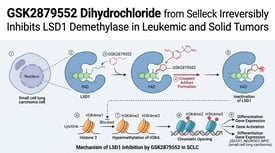
Histone demethylases (HDMs) are a critical class of enzymes that remove methyl groups from lysine and arginine residues on histones, thereby playing a pivotal role in the epigenetic regulation of gene expression. They functionally counteract the activity of histone methyltransferases. The two primary families of HDMs are the Lysine-Specific Demethylases (LSDs), which include LSD1/KDM1A and LSD2/KDM1B, and the Jumonji C (JmjC) domain-containing demethylases (KDMs), which are Fe(II) and α-ketoglutarate-dependent dioxygenases. The outcome of demethylation, whether transcriptional activation or repression, is dependent on the specific histone residue and its methylation state (mono-, di-, or tri-methylation). For example, demethylation of H3K4me1/2 by LSD1 is generally associated with gene repression, whereas demethylation of H3K27me3 by KDM6A/B (UTX/JMJD3) typically leads to gene activation. Aberrant HDM activity is a significant driver of various diseases. Many HDMs are overexpressed or mutated in numerous cancers, promoting oncogenesis by altering gene expression programs critical for cell proliferation, differentiation, and survival. Notable examples include LSD1 (implicated in AML, prostate, and breast cancer), KDM4/JMJD2 (multiple cancers), KDM5/JARID1 (melanoma, prostate cancer), and KDM6/JMJD3 (glioblastoma).
Dysregulation of HDM activity also impacts neuronal development and function, contributing to neurodegenerative conditions such as Alzheimer's and Huntington's disease. Furthermore, HDMs are involved in regulating immune cell differentiation and inflammatory responses, and emerging roles in metabolic regulation are being identified. Significant progress has been made in developing HDM inhibitors, particularly for LSD1. LSD1 inhibitors, especially tranylcypromine (TCP) derivatives, are orally bioavailable, irreversible inhibitors. Seclidemstat (SP-2577) is in Phase I/II trials for Ewing sarcoma and other solid tumors, while mocravimod (IMG-7289) is in Phase II for myelofibrosis and AML. Bomedemstat (IMG-7289) is also in Phase II for myeloproliferative neoplasms. Non-covalent LSD1 inhibitors like GSK2879552 (Phase I for AML) and INCB059872 are also under investigation. For JmjC-domain HDMs, inhibitors targeting KDM5 (e.g., CPI-455, JIB-04) and KDM4 (e.g., NCDM-32B) are in preclinical development for various cancers.
GSK-J4, a pan-JmjC inhibitor with selectivity for KDM6A/B, is a widely used research tool and has shown preclinical efficacy in cancer and inflammatory models. Currently, no HDM inhibitors are approved for clinical use, but several are in advanced clinical trials, particularly for hematological malignancies and solid tumors. HDM inhibitors are classified by their specific HDM family (LSD1 inhibitors, JmjC-domain HDM inhibitors, further sub-classified by KDM target), their mechanism (covalent vs. non-covalent, competitive vs. allosteric), and their diverse chemical structures. Key research tools include TCP, GSK-J4, Parnate (a non-selective MAO inhibitor with LSD1 activity), and S2170 (LSD1). Challenges include achieving high selectivity for specific HDMs due to structural similarities, especially within the JmjC family. Potential for off-target effects and toxicity is a concern due to the widespread roles of HDMs in normal physiology.
Understanding the context-dependent effects of HDM inhibition is also crucial. Combination therapy is a major strategy, with HDM inhibitors being explored alongside other epigenetic therapies (e.g., HDAC inhibitors, BET inhibitors, DNA methyltransferase inhibitors) or conventional chemotherapies/targeted therapies to enhance anti-tumor efficacy and overcome resistance, particularly in cancers driven by specific epigenetic dysregulation.