p300/CBP Inhibitors
p300 (EP300) and CBP (CREB-binding protein) are highly homologous transcriptional coactivators possessing intrinsic histone acetyltransferase (HAT) activity. These enzymes acetylate lysine residues on histones (H3, H4) and a multitude of non-histone proteins, including p53, NF-κB, HIF-1α, and various nuclear receptors. Histone acetylation typically leads to a more open chromatin structure, thereby facilitating gene transcription. Acetylation of non-histone proteins, conversely, regulates their stability, subcellular localization, and enzymatic activity. Functioning as crucial scaffolds, p300/CBP integrate signals from diverse transcription factors and chromatin-modifying enzymes to orchestrate complex gene expression programs vital for cell growth, differentiation, and metabolism. Dysregulation of p300/CBP activity is implicated in a broad spectrum of diseases. In cancer, their roles are context-dependent, acting as both oncogenes and tumor suppressors. Overexpression or activating mutations can drive proliferation in various cancers, including acute myeloid leukemia, prostate cancer, and breast cancer.
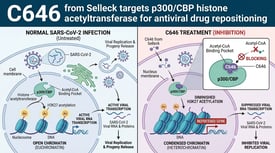
Conversely, loss-of-function mutations are observed in certain cancers and developmental syndromes like Rubinstein-Taybi syndrome, which predisposes individuals to cancer. They are indispensable for the expression of genes involved in cell cycle progression, angiogenesis, and metastasis. Beyond cancer, p300/CBP are key regulators of inflammatory gene expression via pathways like NF-κB, implicating them in inflammatory diseases. They also play roles in metabolic disorders, influencing glucose and lipid metabolism, and are involved in neuronal development and function, linking them to neurodegenerative conditions. Research into p300/CBP inhibitors is predominantly in the preclinical stage, focusing on developing selective small-molecule inhibitors targeting either their HAT activity or their bromodomain interactions. HAT inhibitors like C646, A-485, and CPTH2 are widely utilized research tools. A-485, a potent and selective p300/CBP HAT inhibitor, has demonstrated efficacy in various preclinical cancer models, such as AML and prostate cancer, by inhibiting oncogenic transcription programs. Furthermore, p300/CBP contain bromodomains that recognize acetylated lysines.
Inhibitors targeting these bromodomains, such as SGC-CBP30 and I-CBP112, disrupt crucial protein-protein interactions and have shown preclinical promise in cancer. Despite promising preclinical data, no p300/CBP HAT or bromodomain inhibitors are currently approved or in advanced clinical trials. This is primarily due to challenges in achieving high selectivity and managing potential off-target effects, given their extensive physiological roles. However, the success of BET bromodomain inhibitors (e.g., JQ1), which target a related class of acetyl-lysine readers, provides a strong rationale for continued development. Inhibitors are classified by the domain they target (HAT domain inhibitors, bromodomain inhibitors), their selectivity (pan-p300/CBP inhibitors vs. compounds with some selectivity, though challenging due to high homology), and their diverse chemical structures. Key research tools include C646, A-485, CPTH2 for HAT inhibition, and SGC-CBP30, I-CBP112 for bromodomain inhibition. Major challenges include achieving high selectivity over other HATs and distinguishing between p300 and CBP due to their significant sequence and functional homology.
The broad physiological importance of p300/CBP raises concerns about systemic toxicity from widespread inhibition. Combination therapy strategies are being explored, where p300/CBP inhibitors are combined with other epigenetic modulators (e.g., HDAC inhibitors, BET inhibitors) or standard chemotherapies to enhance anti-tumor effects and overcome resistance, particularly in cancers where p300/CBP activity is a significant driver.