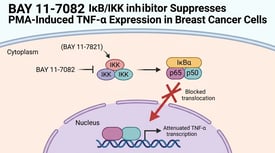
IκB/IKK Inhibitors
The IκB kinase (IKK) complex and its substrate, IκB proteins, are central to the regulation of the NF-κB signaling pathway, a master regulator of inflammation, immunity, and cell survival. The IKK complex is typically composed of two catalytic subunits, IKKα and IKKβ, and a regulatory subunit, NEMO (NF-κB essential modulator). In the canonical NF-κB pathway, which is activated by a vast array of stimuli including cytokines (e.g., TNF-α, IL-1β) and pathogen-associated molecular patterns, IKKβ is the primary kinase responsible for phosphorylating specific serine residues on IκB proteins, most notably IκBα. This phosphorylation event marks IκBα for ubiquitination and subsequent degradation by the 26S proteasome. The degradation of IκBα releases NF-κB dimers (predominantly p50/p65) from their cytoplasmic sequestration, allowing them to translocate to the nucleus where they activate the transcription of target genes involved in inflammatory responses, cell proliferation, and anti-apoptotic pathways. IKKα plays a more prominent role in the non-canonical NF-κB pathway, which is activated by a more restricted set of stimuli (e.g., lymphotoxin β, BAFF) and leads to the processing of p100 to p52.
Aberrant activation of the IKK/NF-κB axis is a key driver in numerous diseases. Chronic inflammatory conditions such as rheumatoid arthritis, inflammatory bowel disease (IBD), and psoriasis are characterized by persistent IKK activation. In oncology, constitutive NF-κB activation, often driven by IKK, promotes tumor growth, survival, metastasis, and resistance to chemotherapy and radiotherapy in a wide range of cancers, including breast, colon, pancreatic, ovarian, and hematological malignancies like multiple myeloma and lymphoma. Given its central role, IKK has emerged as an attractive therapeutic target. Numerous IKK inhibitors have been developed, primarily targeting IKKβ due to its critical role in the canonical pathway. Compounds like BMS-345541, TPCA-1, and MLN120B are well-known ATP-competitive IKKβ inhibitors that have been extensively studied in preclinical models, demonstrating efficacy in reducing inflammation and inhibiting tumor growth.
Some of these have advanced into early clinical trials for inflammatory diseases and various cancers, often as monotherapy or in combination with other agents. Beyond ATP-competitive inhibitors, other classifications include allosteric IKK inhibitors, IKKα-specific inhibitors, and peptides that disrupt the IKK complex, such as NEMO-binding domain (NBD) peptides. Indirect IκB stabilization can also be achieved through proteasome inhibitors like bortezomib, which prevent the degradation of IκB, thereby trapping NF-κB in the cytoplasm. Challenges in developing IKK inhibitors include achieving high selectivity for IKKβ over IKKα and other kinases to minimize off-target effects and systemic toxicity. Given the ubiquitous role of NF-κB in immune responses, broad IKK inhibition can lead to immunosuppression, increasing the risk of infections. Therefore, combination therapy is a critical strategy, particularly in cancer, where IKK inhibitors can synergize with conventional chemotherapies, targeted agents, or immunotherapies to enhance efficacy and overcome resistance.
Further research focuses on identifying biomarkers for patient stratification and developing more isoform-selective and safer IKK inhibitors to unlock their full therapeutic potential.