EZH1 Inhibitors
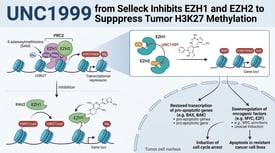
Enhancer of zeste homolog 1 (EZH1) is a catalytic subunit of the Polycomb Repressive Complex 2 (PRC2), a critical epigenetic regulator that mediates the trimethylation of histone H3 at lysine 27 (H3K27me3). This histone modification is a hallmark of transcriptional silencing and plays a fundamental role in maintaining stem cell pluripotency, cell fate determination, and homeostatic gene expression. While its paralog, EZH2, has been extensively studied and targeted in oncology, EZH1 has recently emerged as a vital target due to its redundant and compensatory roles. Unlike EZH2, which is primarily active in proliferating cells, EZH1 is expressed in both cycling and quiescent cells and can maintain H3K27me3 levels even when EZH2 is inhibited or absent. This redundancy often leads to resistance against selective EZH2 inhibitors.
Pathologically, EZH1/2 dysregulation is implicated in various hematological malignancies, including acute myeloid leukemia (AML), non-Hodgkin lymphomas, and multiple myeloma, as well as several solid tumors. In these cancers, hypermethylation of H3K27 leads to the silencing of tumor suppressor genes. EZH1 inhibitors are generally developed as part of dual EZH1/2 inhibitory scaffolds to ensure complete blockade of PRC2 activity. The most significant progress in this field is the development of valemetostat (DS-3201), a first-in-class dual EZH1/2 inhibitor. Valemetostat has demonstrated potent clinical activity and was recently approved in Japan for the treatment of relapsed or refractory adult T-cell leukemia/lymphoma (ATL).
Other dual inhibitors, such as UNC0638 and various preclinical compounds, are being used to explore the therapeutic potential of PRC2 inhibition in other malignancies. These inhibitors are typically ATP-competitive small molecules that bind to the S-adenosylmethionine (SAM) binding pocket of the SET domain. The classification of these inhibitors often distinguishes between those that are highly selective for EZH2 and the newer generation of dual EZH1/2 inhibitors. A major challenge in the clinical use of EZH1/2 inhibitors is the potential for hematological toxicity, such as thrombocytopenia and neutropenia, which stems from the essential role of PRC2 in normal hematopoiesis. Current research is focusing on optimizing dosing schedules and exploring combination therapies with other epigenetic modulators, such as HDAC inhibitors or DNA methyltransferase inhibitors, to achieve synergistic effects.
Additionally, the role of EZH1 in non-canonical functions and its interaction with other chromatin remodeling complexes are areas of active investigation. As more dual EZH1/2 inhibitors enter clinical trials, the focus remains on identifying specific patient populations that will benefit most from this epigenetic intervention and overcoming the mechanisms of acquired resistance that may arise during long-term treatment.