UNC1999 from Selleck Inhibits EZH1 and EZH2 to Suppress Tumor H3K27 Methylation
Copy code to add this image to your page
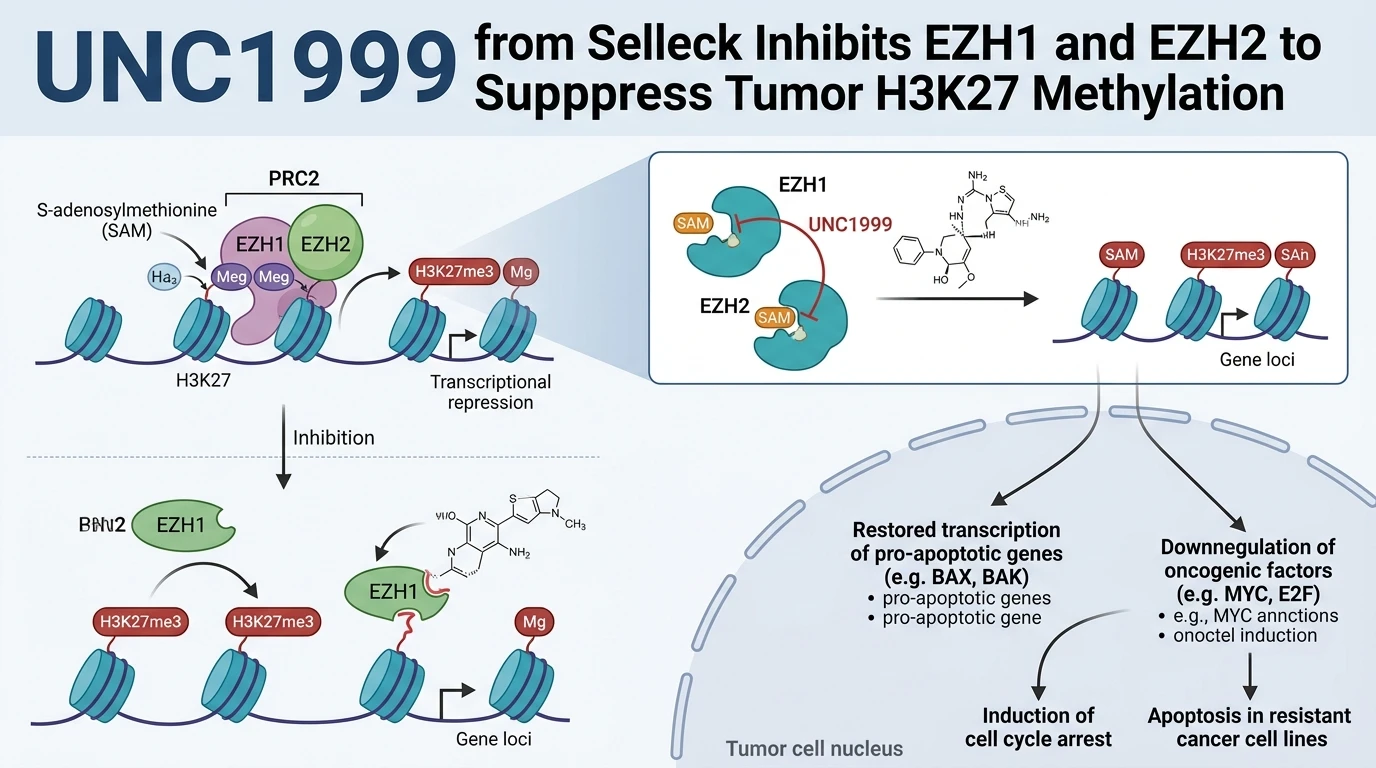
Epigenetic regulation through post-translational modification of histone tails constitutes a foundational mechanism governing chromatin architecture and transcriptional program execution. Among these modifications, lysine 27 trimethylation on histone H3 (H3K27me3) serves as a primary repressive epigenetic mark required for maintaining cell identity, lineage fidelity, and stem cell pluripotency. The enzymatic deposition of methyl groups onto H3K27 is catalyzed exclusively by Polycomb Repressive Complex 2 (PRC2), a multi-subunit protein assembly comprising structural components SUZ12 and EED alongside one of two mutually exclusive catalytic engines: Enhancer of Zeste Homolog 1 (EZH1) or Enhancer of Zeste Homolog 2 (EZH2). While EZH2 expression predominates in actively dividing somatic tissues and frequently undergoes overexpression or gain-of-function mutation in aggressive malignancies, EZH1 is expressed in both cycling and non-cycling cells, maintaining baseline H3K27 methylation and sustaining gene repression when EZH2 catalytic output is compromised.
Biochemical and structural characterization revealed that both EZH1 and EZH2 transfer methyl groups from the ubiquitous cofactor S-adenosylmethionine (SAM) to the lysine epsilon-amino group of H3K27. High-throughput chemical screening and rational design identified UNC1999 as an orally bioavailable, SAM-competitive dual inhibitor capable of engaging both catalytic paralogs. Structural studies demonstrate that UNC1999 occupies the pocket usually bound by the adenosyl and methionine moieties of SAM within the SET domain of EZH2 and EZH1. Notably, this competitive engagement occurs without displacing or obstructing the nucleosomal DNA or histone peptide substrate. Enzymatic inhibition assays demonstrate high catalytic potency against recombinant EZH2, displaying an IC50 of approximately 2 nM, while exhibiting an IC50 of approximately 45 nM against EZH1, reflecting an approximate 10-fold selectivity ratio for EZH2 over EZH1. This balanced dual reactivity profile allows UNC1999 from Selleck to suppress both PRC2 catalytic cores, effectively blunting compensatory enzymatic activation by EZH1 in cellular settings where both paralogs are operational.
In preclinical cellular assays, administration of UNC1999 triggers a rapid, concentration-dependent reduction in cellular H3K27me2 and H3K27me3 levels. Depletion of these repressive marks alters chromatin accessibility across promoter and enhancer regions, resulting in the transcriptional reactivation of silence-prone tumor suppressor genes. Prominent among these reactivation targets are cell cycle regulators such as CDKN2A (p16INK4A), CDKN1A (p21), and pro-apoptotic BH3-only proteins including BIM. Simultaneously, loss of H3K27me3 attenuates the expression of key oncogenic drivers, including MYC and CCND1, through mechanisms involving altered distant enhancer activation and transcription factor clearing. Evaluation across various cancer lineages shows robust antiproliferative and pro-apoptotic activity in acute myeloid leukemia (AML), diffuse large B-cell lymphoma (DLBCL), multiple myeloma, bladder carcinoma, and colon adenocarcinoma models.
A major therapeutic challenge associated with selective EZH2 monotherapy, such as treatment with Tazemetostat or GSK126, is the swift emergence of acquired drug resistance. Clinical and preclinical investigations indicate that resistance frequently develops via secondary point mutations in the EZH2 SET domain (e.g., Y641N, A677G, or A687V) or through transcriptional up-regulation and recruitment of EZH1 to PRC2 complexes, thereby sustaining repressive H3K27 methylation states. Pharmacological characterization reveals that UNC1999 retains potent activity in cell lines harboring EZH2 secondary mutations and in models exhibiting EZH1-mediated resistance. By occupying the SAM-binding pockets of both EZH1 and EZH2 simultaneously, UNC1999 blocks total PRC2 catalytic capacity, suppressing residual methylation activity that drives resistance to single-isoform inhibitors. Pharmacokinetic assessments in rodent species confirm favourable oral bioavailability, extended terminal half-life, and robust pharmacodynamic target engagement in vivo, establishing UNC1999 as a vital tool for studying dual PRC2 suppression in complex cancer phenotypes.
Pharmacological Characterization and Efficacy in Preclinical Models
Copy code to add this image to your page
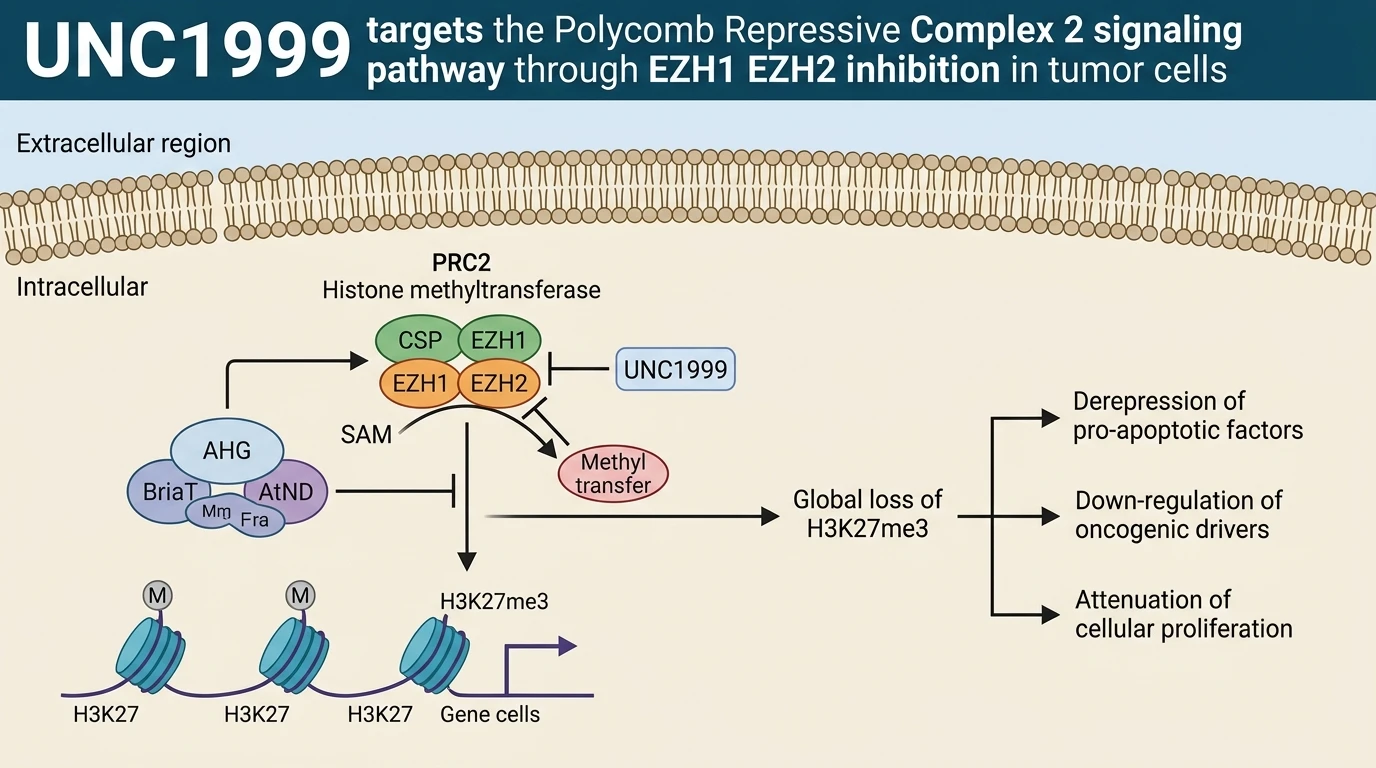
UNC1999 is an orally bioavailable dual inhibitor targeting the catalytic subunits EZH1 and EZH2 of Polycomb Repressive Complex 2. By competing with S-adenosylmethionine (SAM) for binding within the catalytic domain, UNC1999 prevents methyl transfer to lysine 27 of histone H3 without perturbing substrate peptide binding. This dual inhibition depletes global H3K27me3 levels, derepresses tumor suppressor genes, downregulates oncogenic drivers, and restores apoptotic signaling across diverse hematologic and solid tumor models, including cell lines resistant to selective EZH2 inhibitors.
Dual Isoform Targeting Overcomes Selective Inhibitor Resistance
Monotherapy using EZH2-selective agents often leads to therapeutic failure through EZH1 compensation. To evaluate whether dual inhibition circumvents this operational redundancy, comparative studies were performed in mutant EZH2-driven lymphoma and resistant leukemia lines. Exposure to UNC1999 from Selleck produced sustained reductions in global H3K27me3 marks at nanomolar concentrations. Cellular proliferation decreased rapidly within 72 hours of administration. Crucially, cell lines displaying acquired resistance to Tazemetostat or GSK126 remained sensitive to UNC1999. Kinetic analysis confirmed equivalent binding affinities regardless of common secondary EZH2 catalytic domain variants. These observations demonstrate that targeting both EZH1 and EZH2 subunits effectively blocks compensatory methyltransferase activity in drug-resistant backgrounds.
Transcriptional Reactivation and Apoptotic Cascades in Solid Tumors
PRC2 hyperactivation silences regulatory gene networks in solid neoplasms. In bladder and colon carcinoma cell cultures treated with UNC1999, chromatin immunoprecipitation coupled with sequencing revealed significant H3K27me3 depletion at tumor suppressor promoters. The loss of repressive marks restored expression of p21 and BIM. Downstream caspase-3 cleavage expanded fourfold after four days. Apoptosis rates rose steadily across tested dose cohorts. Concurrently, oncogenic signaling cascades mediated by MYC and CCND1 underwent pronounced down-regulation. These transcriptional shifts correlated with reduced colony formation in soft agar assays. In patient-derived xenograft models, oral administration of UNC1999 yielded measurable tumor growth inhibition without overt body weight loss.