Rimiducid (AP1903) AP1903 activator dependent inducible caspase-9 safety switch activation in stem cell immunotherapies
Copy code to add this image to your page
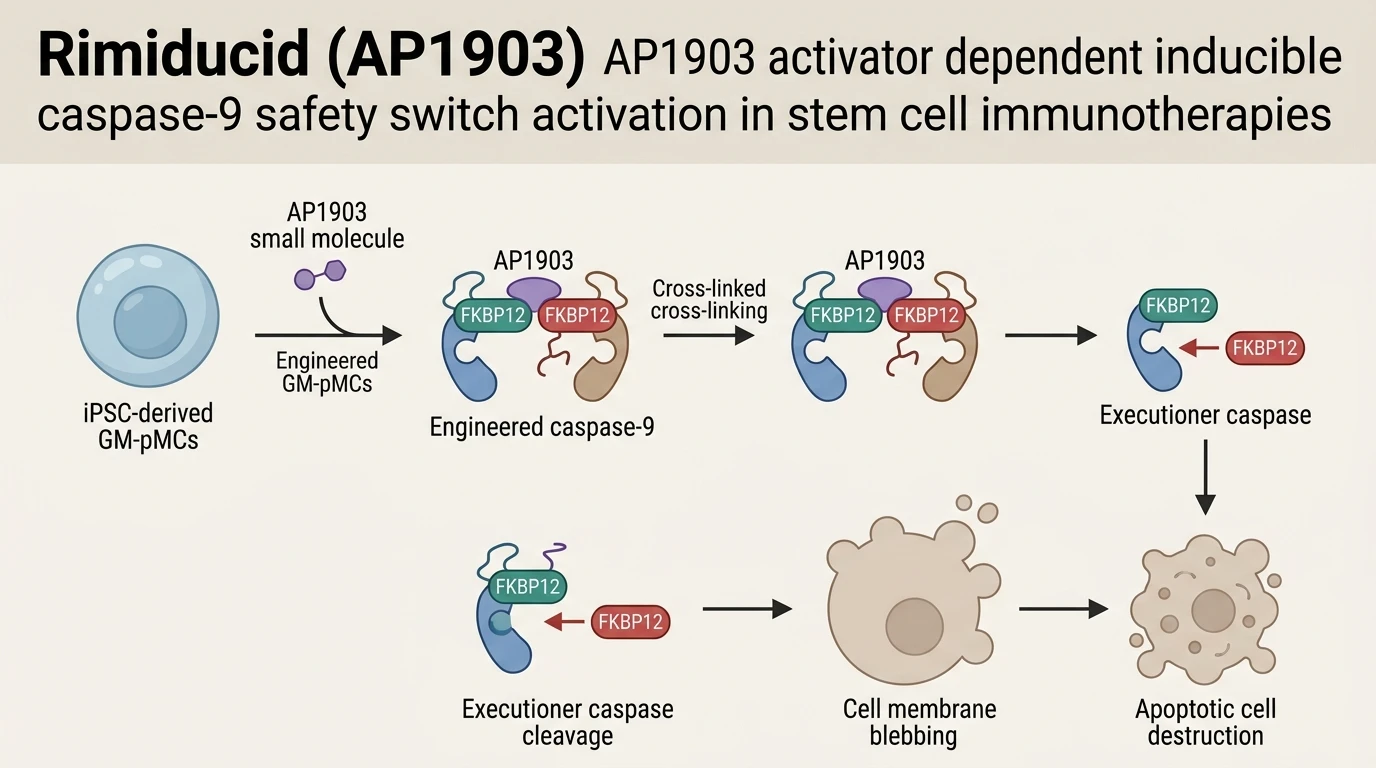
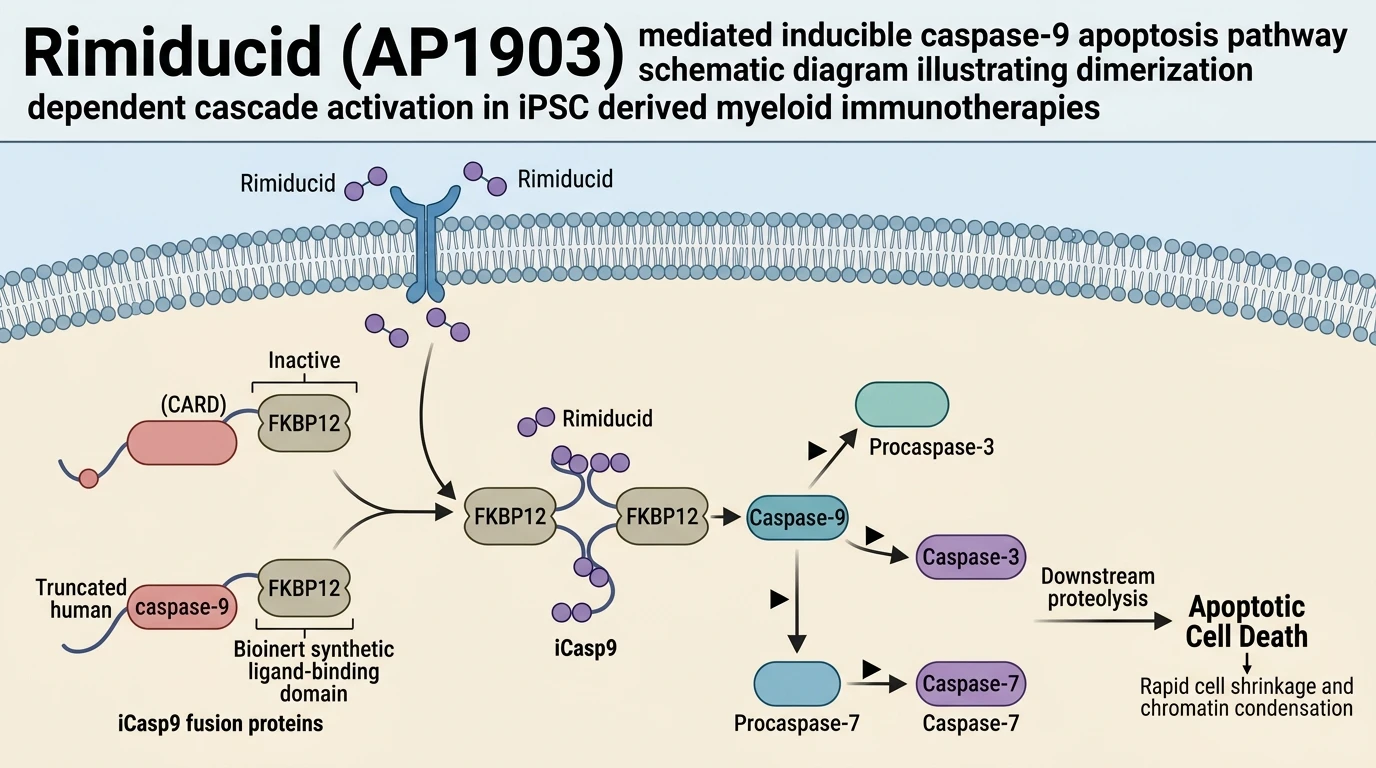
Pluripotent stem cell-derived immunotherapies, including granulocyte-macrophage colony-stimulating factor-producing proliferating myeloid cells (GM-pMCs), represent a flexible platform for cellular vaccination and targeted cancer immunotherapy. Despite their robust expansion potential and sustained cytokine secretion profile, long-term persistence or uncontrollable proliferation in vivo poses theoretical risks of insertional mutagenesis, lineage skewing, or off-target tissue inflammation. To mitigate these safety concerns, suicide gene systems serve as fail-safe switches capable of eliminating engineered cellular products upon pharmacologic activation. Comparative evaluation of suicide gene architectures highlights fundamental differences in clearance kinetics, metabolic dependency, and bystander cytotoxicity. The herpes simplex virus-thymidine kinase with ganciclovir (HSV-TK/GCV) pathway represents a traditional suicide gene system. HSV-TK converts the prodrug ganciclovir into ganciclovir monophosphate, which endogenous cellular kinases subsequently phosphorylate into ganciclovir triphosphate. This cytotoxic metabolite incorporates into nascent DNA during the S-phase of the cell cycle, terminating DNA strand elongation and inducing secondary apoptosis. However, because HSV-TK cytotoxicity depends strictly on active cell division, non-dividing or quiescent cell populations resist rapid clearance. Furthermore, ganciclovir metabolites can transfer to adjacent non-engineered cells via gap junctions, causing unintended bystander killing. Elevated systemic ganciclovir concentrations also introduce metabolic toxicities independent of safety switch expression. In contrast, the inducible caspase-9 (iCasp9) system operates via direct, proliferation-independent signal transduction. The iCasp9 construct consists of a human FK506-binding protein (FKBP12) with a single-amino-acid substitution (F36V) linked via a flexible bridge to a human procaspase-9 domain lacking its endogenous caspase recruitment domain (CARD). Rimiducid (AP1903) is a synthetic, divalent small-molecule homodimerizer designed specifically to engage the FKBP12(F36V) domain with nanomolar affinity while displaying negligible affinity for wild-type FKBP12. Binding of a single AP1903 molecule to two adjacent FKBP12(F36V) domains enforces homodimerization of caspase-9 zymogens, triggering conformational rearrangements that expose the catalytic active site. Upon AP1903 engagement, dimerized iCasp9 rapidly auto-activates and initiates catalytic cleavage of executioner procaspase-3 and procaspase-7 into their active tetrameric forms. These executioner caspases systematically cleave key structural and functional intracellular substrates, including poly(ADP-ribose) polymerase (PARP) and inhibitor of caspase-activated DNase (ICAD). Cleavage triggers characteristic apoptotic hallmarks—chromatin condensation, nuclear fragmentation, cell membrane blebbing, and exposure of phosphatidylserine on the outer leaflet—within minutes to hours. Because this mechanism relies solely on physical protein dimerization rather than metabolic conversion or cell cycle progression, iCasp9 activation destroys both proliferating and quiescent target cells rapidly. Experimental evaluation of iPSC-derived GM-pMCs transduced with either iCasp9 or HSV-TK demonstrated that gene insertion and constitutive baseline switch expression did not compromise cellular identity or functional potency. Transduced GM-pMCs maintained normal surface marker profiles (CD11b, CD14, and HLA-DR expression), persistent secretion of functional GM-CSF, and preserved antitumor vaccination efficacy in preclinical murine tumor models. However, upon exposure to AP1903, iCasp9-expressing GM-pMCs exhibited dramatically accelerated apoptotic kinetics relative to HSV-TK-expressing cells exposed to ganciclovir. In vitro kill assays confirmed near-complete elimination of iCasp9 GM-pMCs within two to four hours of AP1903 exposure. In contrast, HSV-TK cell destruction required forty-eight to seventy-two hours of continuous ganciclovir treatment. In vivo murine xenograft models reinforced these kinetic differences. Systemic administration of Rimiducid (AP1903) led to rapid target cell elimination within twenty-four hours, whereas ganciclovir treatment required multi-day dosing regimens to achieve comparable graft clearance. Crucially, AP1903 exhibited a high safety margin; non-transduced host cells and parent iPSCs suffered no viability loss even at concentrations significantly exceeding pharmacologically effective levels. These findings confirm that the iCasp9/AP1903 safety switch provides superior kinetic control, high specificity, and an optimal safety profile for safeguarding iPSC-derived myeloid cell therapies in preclinical settings.
Therapeutic Evaluation and Comparative Safety Switch Kinetics
Copy code to add this image to your page
Rimiducid (AP1903) operates as a lipid-soluble, divalent homodimerizer ligand that selectively binds mutated FKBP12 domains fused to truncated human caspase-9 (iCasp9). Ligand engagement forces spatial proximity and catalytic dimerization of caspase-9 zymogens, bypassing upstream death receptor signaling. Active iCasp9 directly cleaves effector procaspases 3 and 7, initiating intrinsic apoptotic proteolysis, cellular shrinkage, and nuclear fragmentation. This mechanism enables target-selective clearance of engineered cell therapies without reliance on cellular proliferation or off-target host tissue toxicity.
Rapid Apoptotic Induction in iPSC-Derived Myeloid Cells
Cellular clearance required minimal time following exposure. In controlled in vitro assays, application of the AP1903 activator rapidly induced dimeric cross-linking of the engineered iCasp9 construct within minutes, triggering downstream activation of caspase family proteases. Executioner caspase-3 and caspase-7 cleavage occurred rapidly thereafter. Within four hours post-administration, over ninety percent of transduced granulocyte-macrophage colony-stimulating factor-producing proliferating myeloid cells underwent programmed cell death. Murine xenograft models confirmed equivalent clearance dynamics in vivo. Systemic administration cleared engineered cellular grafts without delayed latency. In contrast, the herpes simplex virus-thymidine kinase system required prolonged ganciclovir exposure spanning multiple cell division cycles. This multi-day requirement highlights a major kinetic constraint of enzymatic prodrug conversion.
Bioinert Pharmacological Profile Prevents Non-Specific Host Cytotoxicity
Off-target cell death remained absent during therapeutic dimerizer administration. Evaluated across broad concentration ranges in vitro, the AP1903 activator exhibited no measurable cytotoxicity against non-transduced bystander cells. Healthy parent iPSCs and native immune subsets maintained full viability under equivalent treatment conditions. Conversely, elevated ganciclovir concentrations generated noticeable off-target toxicity in non-transduced bystander cells during metabolic nucleoside incorporation. Systemic administration of the small-molecule dimerizer produced no observable systemic clinical signs or biochemical liver and kidney enzyme elevations in animal models. The inert nature of the synthetic homodimerizer ensures target-specific elimination restricted strictly to iCasp9-expressing cellular grafts.