Sonidegib (NVP-LDE225, Erismodegib) NVPLDE225, Erismodegib Smoothened Receptor Inhibition in Advanced Basal Cell Carcinoma
Copy code to add this image to your page
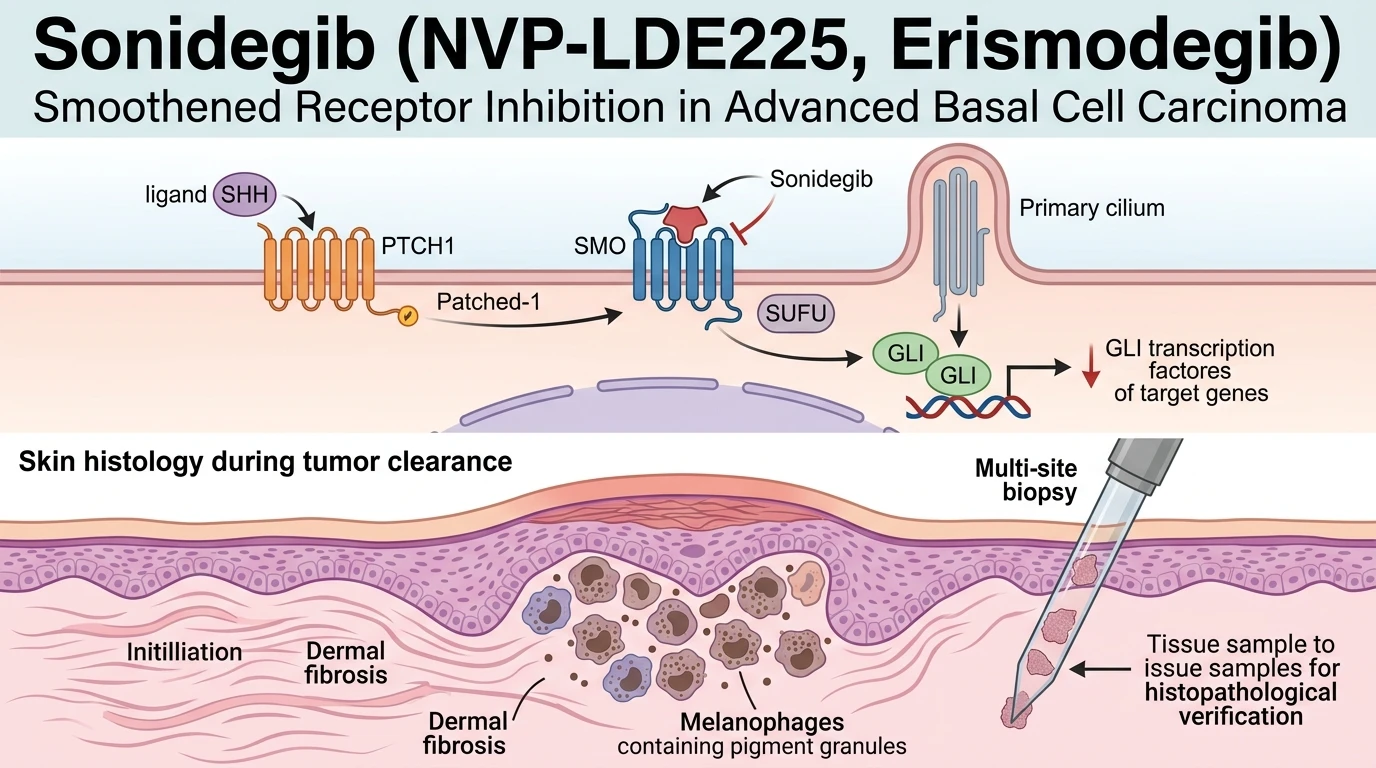
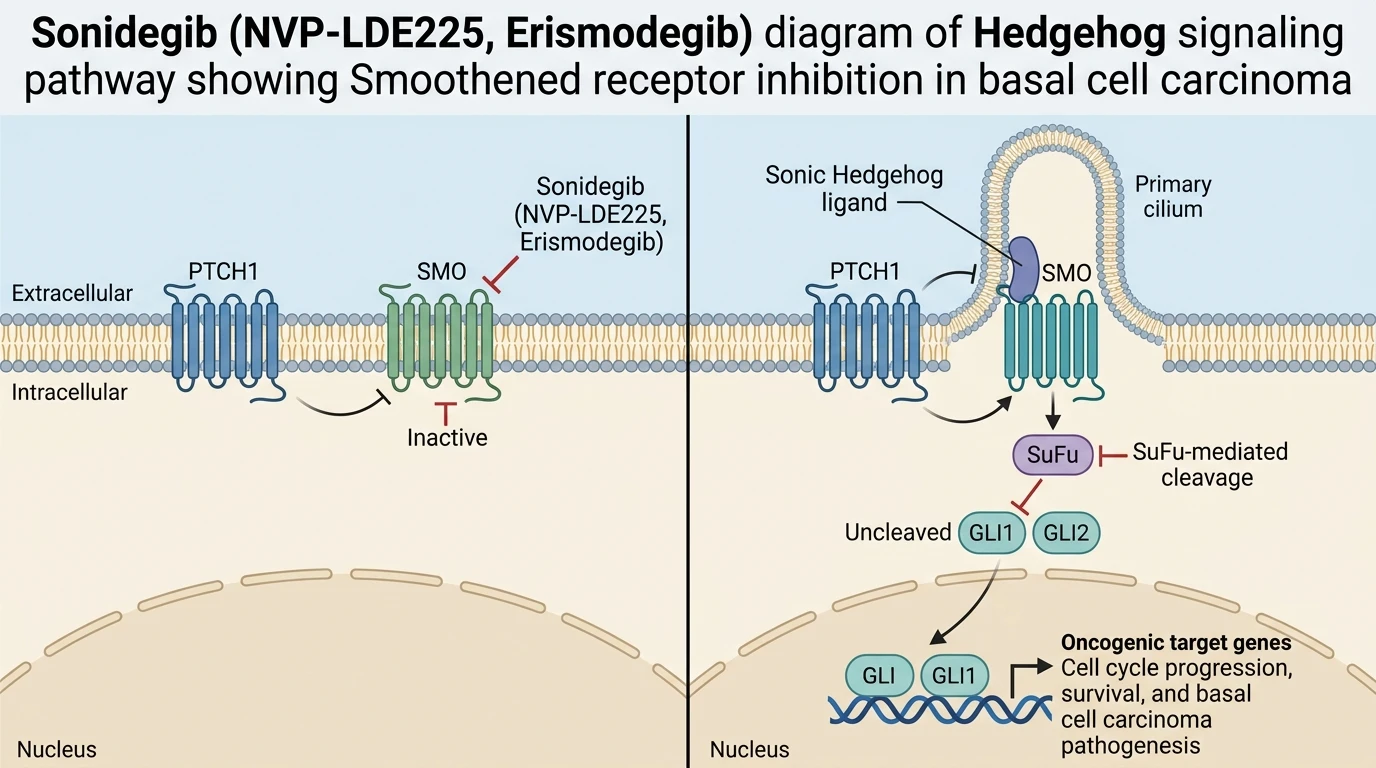
Aberrant activation of the Hedgehog signaling cascade serves as the primary molecular driver in the pathogenesis of locally advanced basal cell carcinoma (laBCC). The transmembrane protein Smoothened (SMO) receptor acts as a central signal transducer within this biochemical pathway. Under physiological unliganded conditions, the twelve-transmembrane receptor Patched-1 (PTCH1) maintains SMO in a state of tonic suppression. Inactivating mutations in PTCH1 or activating point mutations in SMO disrupt this homeostatic constraint, leading to constitutive signal propagation. Uninhibited signaling drives the nuclear accumulation of GLI family transcription factors (GLI1 and GLI2), inducing gene transcription networks that promote uncontrolled keratinocyte proliferation and survival. Sonidegib (NVP-LDE225, Erismodegib) functions as a selective, bioavailable, oral small-molecule antagonist of the SMO receptor. By binding specifically to the seven-transmembrane helical bundle of SMO, Sonidegib prevents receptor activation, C-terminal tail phosphorylation, and subsequent primary cilia localization. Consequently, downstream transcript activation of GLI target genes is blocked.
In a real-world clinical investigation, 54 Chinese patients diagnosed with locally advanced basal cell carcinoma received oral Sonidegib (NVP-LDE225, Erismodegib) at a standard daily dosage of 200 mg for a minimum duration of three months. Quantitative efficacy metrics demonstrated marked antitumor activity within this patient population. The objective response rate (ORR) reached 87.0%, comprising a complete response (CR) rate of 48.1% and a partial response (PR) rate of 38.9%. Furthermore, the treatment yielded a 100% disease control rate across the evaluated cohort. Histopathological examination confirmed these findings, revealing complete pathological tumor clearance in 48.1% of patients post-treatment.
Despite high clinical response rates, non-invasive visual assessments exhibited notable diagnostic limitations when compared against definitive histopathological endpoints. Clinical and dermoscopic evaluations demonstrated substantial false-positive rates, reaching 61.5% on dermoscopy. Microscopic analysis revealed that residual dermoscopic structures and altered skin pigmentation were frequently driven by non-neoplastic tissue responses rather than persistent carcinoma. Post-treatment histological examinations identified abundant pigment-laden macrophages, termed melanophages, residing within the upper dermis following malignant cell destruction. Concurrently, dense collagenous stroma and scar-associated dermal fibrosis generated persistent clinical induration and altered light scattering. These benign physiological alterations closely resemble residual basal cell carcinoma during standard visual and dermoscopic examinations.
To address this diagnostic discrepancy, clinical protocols required dermoscopy-guided multi-site punch biopsy for accurate outcome verification. Dermoscopy effectively pinpoints suspicious sub-regions characterized by residual vascularity, ulceration, or focal pigment structures. However, tissue biopsy remains mandatory to differentiate active residual malignancy from post-therapeutic dermal scar tissue and macrophage accumulation. Implementing dermoscopy-guided multi-site sampling prevents unnecessary treatment extensions or premature surgical interventions in patients who have already achieved complete pathological clearance.
Safety assessments confirmed a manageable safety profile for extended daily administration of Sonidegib (NVP-LDE225, Erismodegib). Overall, 81.5% of patients reported treatment-emergent adverse events, all ranging between grade 1 and 3 in severity. The most frequent toxicities included muscle cramps, dysgeusia, and alopecia. These adverse events represent predictable pharmacodynamic manifestations of systemic SMO inhibition in adult stem cell niches, specifically within skeletal muscle, gustatory taste buds, and hair follicles. Notably, side effects were controlled through supportive care, and no patients discontinued treatment due to drug-related toxicities.
Therapeutic Efficacy and Histopathological Diagnostic Criteria
Copy code to add this image to your page
Sonidegib is a selective, potent antagonist of the Smoothened (SMO) receptor, a central component of the Hedgehog signaling pathway. By binding to the transmembrane domain of SMO, sonidegib prevents its activation and primary cilia translocation, disrupting downstream GLI transcription factor activation. In locally advanced basal cell carcinoma, this targeted inhibition halts tumor cell proliferation and induces cell death. While clinical response rates are high, posttreatment scarring and dermal melanophages cause high false-positive visual assessments, necessitating dermoscopy-guided multi-site biopsy to confirm complete pathological response.
High Rates of Objective Response and Pathological Complete Clearance
Systemic administration of NVPLDE225, Erismodegib at 200 mg daily induced rapid tumor regression in Chinese patients with locally advanced basal cell carcinoma. The objective response rate reached 87.0%. Complete clinical responses occurred in 48.1% of subjects. Partial responses accounted for 38.9%. Every patient achieved disease control. Histopathology confirmed complete clearance in 48.1% of biopsies. These metrics reflect potent suppression of canonical Hedgehog signaling within the tumor microenvironment. Blockade of Smoothened halts GLI-driven transcription. Apoptosis increases rapidly in target keratinocytes. Tumor mass diminishes within weeks of initiating therapy.
Histopathological Substrates Underlying Dermoscopic False-Positive Assessments
Clinical evaluation often fails to distinguish active malignant tissue from post-therapeutic remodeling. Dermoscopy yielded a 61.5% false-positive rate when evaluating residual lesion sites. Microscopic examination revealed extensive dermal fibrosis alongside dense clusters of pigment-laden macrophages. These melanophages linger long after tumor cell lysis occurs. Residual melanin granules scatter polarized light, mimicking active pigmented nests under dermoscopic inspection. Concurrently, dense collagen deposition generates palpably firm plaques. True clearance confirmation requires multi-site tissue sampling. Dermoscopy-guided punch biopsies prevent incorrect therapeutic escalations by validating complete histological cure.
Manageable Toxicity Profile under Extended Smoothened Inhibition
Continuous daily dosing with NVPLDE225, Erismodegib demonstrated an acceptable safety profile across the treated population. Adverse events occurred in 81.5% of patients. All events were categorized as grade 1 to 3 in severity. Muscle cramps were reported most frequently, followed by dysgeusia and alopecia. These toxicities stem directly from SMO inhibition in non-neoplastic tissue niches. Ciliary Hedgehog signaling maintains adult muscle homeostasis, gustatory receptor cell renewal, and follicular cycling. Importantly, toxicity management required no drug discontinuations. Dose retention remained 100% throughout the protocol.