Purmorphamine Selectively Activates Frizzled 6 Biased Signaling via Seven-Transmembrane Core Pocket Engagement
Copy code to add this image to your page
The Class F G protein-coupled receptor (GPCR) family, encompassing Smoothened (SMO) and the ten Frizzled receptors (FZD1–10), orchestrates complex morphogenetic signaling networks critical for embryonic development and adult tissue homeostasis. While SMO has long served as a primary drug target within the Hedgehog signaling cascade, targeted pharmacological manipulation of individual Frizzled receptors has remained challenging due to structural conservation across their extracellular cysteine-rich domains (CRDs) and deep seven-transmembrane (7TM) core pockets. Recent structural biology advances have revealed that small molecules can directly engage the orthosteric or allosteric cavities of class F receptors. Within this framework, Purmorphamine, traditionally characterized as a synthetic small-molecule SMO agonist, demonstrates functional cross-reactivity with Frizzled 6 (FZD6), acting as a selective partial agonist.
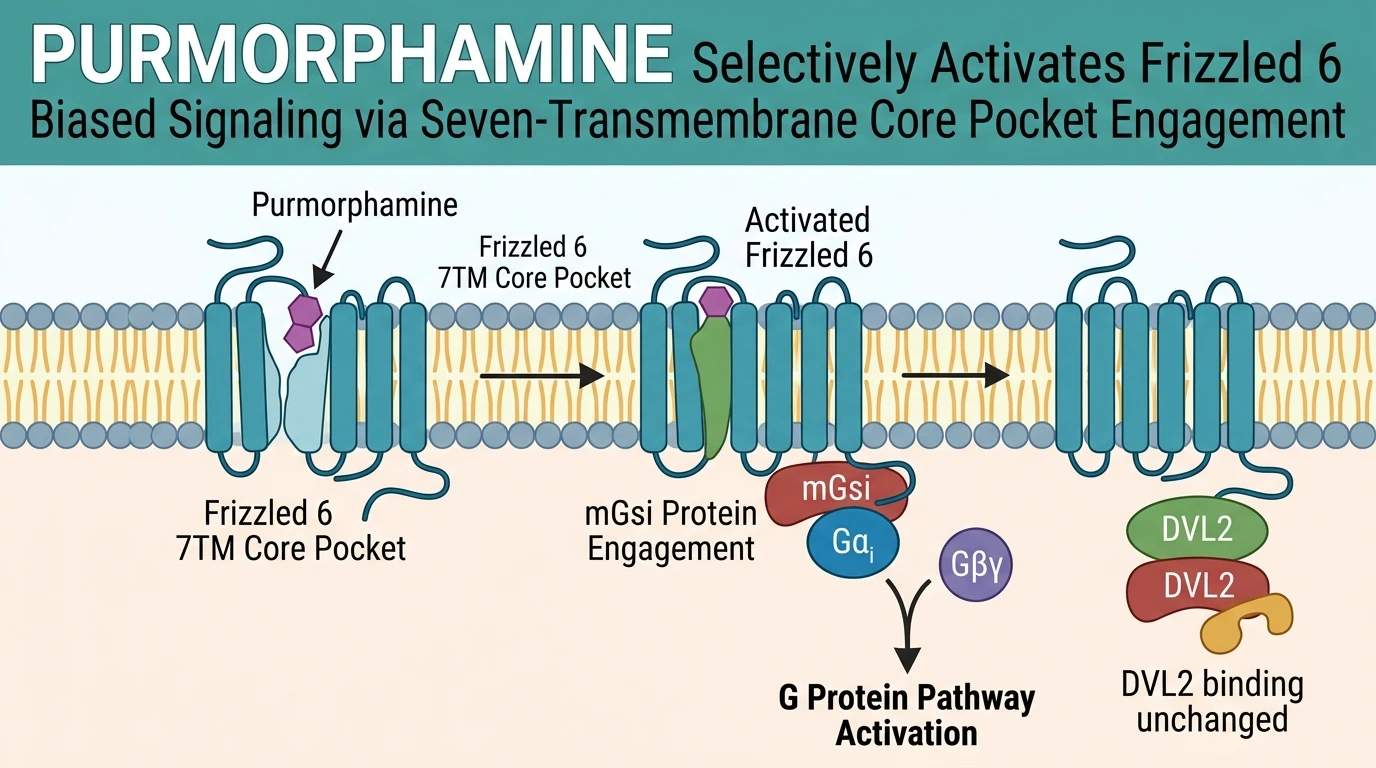
Computational molecular docking combined with site-directed mutagenesis studies reveals that Purmorphamine engages the hydrophobic 7TM bundle of FZD6. The binding footprint significantly overlaps with the pocket occupied by SAG1.3, another established class F ligand. Within this pocket, critical amino acid residues residing on transmembrane helices 3, 5, and 6 form hydrophobic contacts and hydrogen-bonding networks that stabilize an active receptor conformation. Ligand binding within this core cavity induces outward displacement of transmembrane helix 6, creating an intracellular cavity optimized for transducer engagement.
Upon binding to the 7TM pocket of FZD6, Purmorphamine drives concentration-dependent recruitment of the engineered mini-G protein mGsi. In reconstituted membrane systems and intact cell functional assays, this recruitment translates into robust heterotrimeric G protein activation. Notably, the concentration-response profile of Purmorphamine displays classic sigmoidal saturation kinetics. This behavior contrasts sharply with the biphasic, bell-shaped concentration-response curves frequently recorded for SAG1.3 in identical G protein coupling assays. The absence of high-concentration autoinhibition suggests that Purmorphamine stabilizes a distinct receptor active state without inducing higher-order receptor oligomerization or steric self-antagonism within tested in vitro concentration ranges.
Beyond G protein activation, functional profiling demonstrates pronounced signaling bias. Class F receptors typically signal through dual downstream cascades: heterotrimeric G protein pathways and cytosolic scaffold interactions mediated by Dishevelled proteins (DVL1–3). Structural measurements assessing intracellular protein dynamics demonstrate that Purmorphamine engagement does not perturb or modulate the baseline interaction between FZD6 and Dishevelled 2 (DVL2). While SAG1.3 triggers observable alterations in DVL2 cytosolic recruitment and phosphorylation patterns, Purmorphamine leaves the FZD6-DVL2 interface entirely unaffected.
This functional bifurcation highlights a hallmark example of ligand-directed biased signaling at a class F GPCR. By selectively promoting mGsi coupling while remaining completely neutral toward DVL2 recruitment, Purmorphamine demonstrates that transducer engagement can be uncoupled at the structural level within the FZD6 7TM core. This selective activation modality provides a refined chemical tool for dissecting G protein-dependent branches of FZD6 signaling in isolation from non-canonical or planar cell polarity cascades dependent on DVL scaffolds. These empirical insights confirm that the 7TM core pocket of FZD6 possesses sufficient structural plasticity to accommodate diverse chemical scaffolds, establishing a rational foundation for designing pathway-selective class F modulators.
Pharmacological Profiling and Biased Transducer Activation
Copy code to add this image to your page
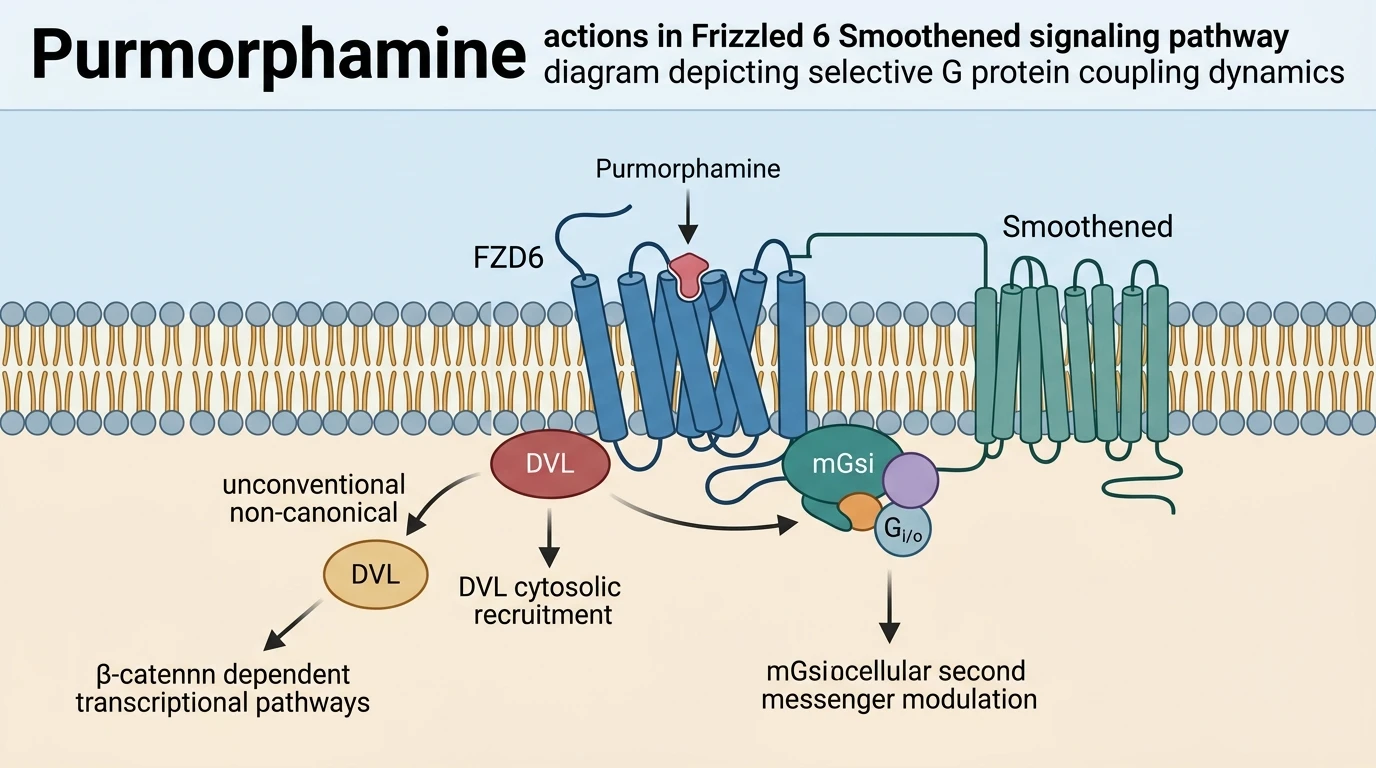
Purmorphamine acts as a functionally biased partial agonist of Frizzled 6 (FZD6), engaging its seven-transmembrane (7TM) core binding pocket. Pocket occupancy induces conformational shifts that selectively promote heterotrimeric G protein and mGsi recruitment. Crucially, Purmorphamine exhibits non-biphasic concentration-response kinetics and leaves intracellular FZD6-DVL2 scaffold interactions completely unperturbed, isolating G protein pathways from Dishevelled signaling.
7TM Core Engagement and Monophasic G Protein Kinetics
Molecular modeling confirms that Purmorphamine occupies the deep 7TM pocket of FZD6. The compound forms conserved hydrophobic interactions along transmembrane helices 3 and 6. In nanoBRET-based transducer assays, ligand binding triggered immediate mGsi recruitment. Maximum activation occurred at low micromolar concentrations. Downstream signal accumulation followed monophasic, sigmoidal kinetics across all tested doses. Unlike SAG1.3, no high-concentration signal attenuation was observed in vitro. These observations demonstrate linear efficacy within this specific cellular system.
Uncoupling of mGsi Activation from DVL2 Scaffold Dynamics
Class F GPCRs coordinate multiple intracellular effectors upon activation. Co-immunoprecipitation and fluorescence recovery assays measured effector recruitment following ligand challenge. Purmorphamine failed to alter baseline FZD6-DVL2 association dynamics. Intracellular DVL2 cytosolic localization remained stable across all concentration gradients evaluated. G protein recruitment proceeded independently of Dishevelled interaction changes. The selectivity margin remained completely intact. These empirical metrics confirm pathway-biased activation downstream of FZD6 core engagement.
Structural Plasticity of the FZD6 Orthosteric Pocket
Comparison between SAG1.3 and small-molecule agonists reveals distinct binding mode adaptations within FZD6. Small molecules accommodate specific sub-pockets without altering cytosolic loop geometry required for DVL binding. Heterotrimeric G protein activation remained isolated from scaffold-mediated pathways under tested cell assay conditions. Receptor activation dynamics suggest that 7TM targeted molecules can selectively drive primary transducer pathways. Future structural studies will further clarify ligand-receptor residence times in living cells.