Tasquinimod HDAC modulator Targets S100A9 to Block MDSC Recruitment and Angiogenesis
Copy code to add this image to your page
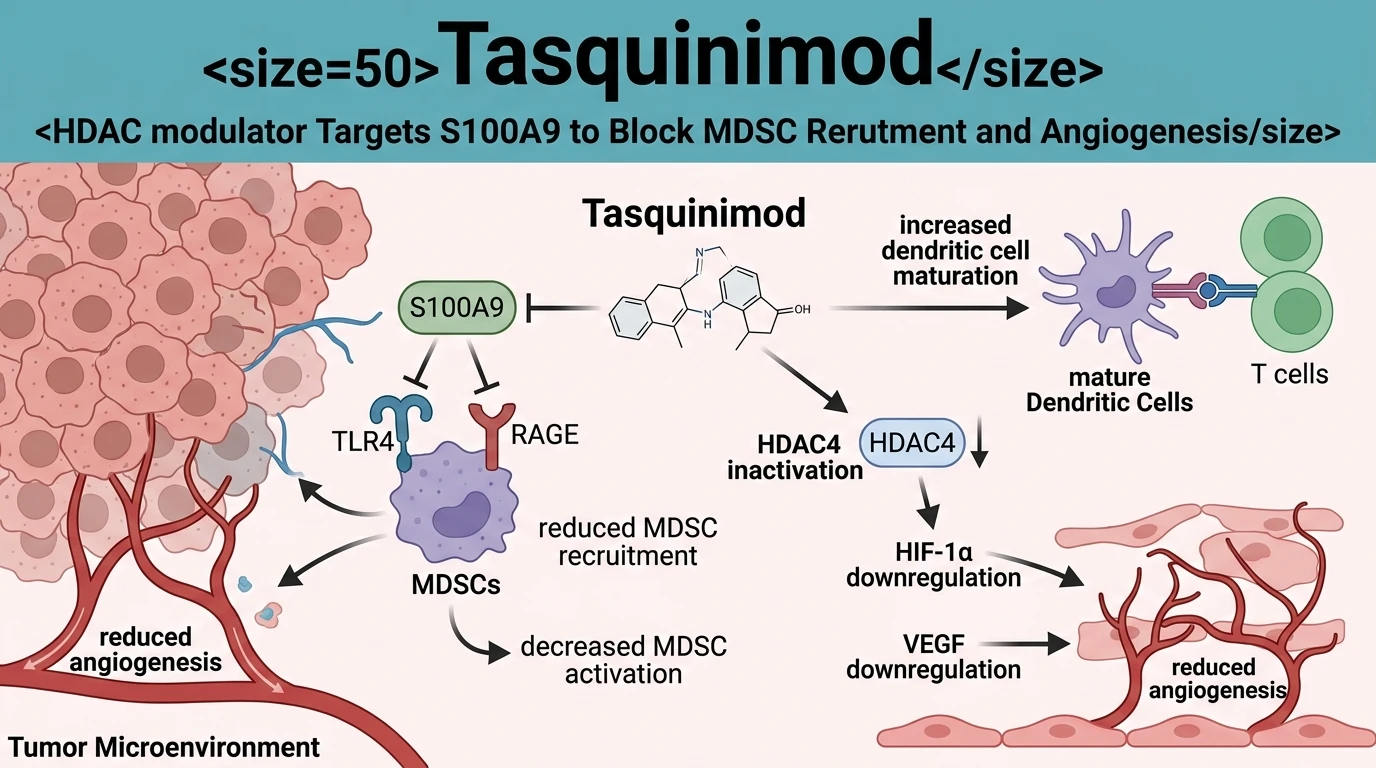
Tasquinimod is a small-molecule oral quinoline-3-carboxamide derivative designed to selectively target the tumor microenvironment in metastatic castration-resistant prostate cancer (mCRPC). The compound exhibits dual pharmacological actions: immunomodulation and inhibition of angiogenesis. Primary target engagement centres on S100 calcium-binding protein A9 (S100A9), an inflammatory protein upregulated in malignant tissues and infiltrating immune subsets. Under physiological conditions, extracellular S100A9 homodimers or heterodimers interact with Toll-like receptor 4 (TLR4) and the receptor for advanced glycation end-products (RAGE). Signaling through these surface receptors promotes the recruitment, mobilization, and intratumoral accumulation of myeloid-derived suppressor cells (MDSCs). These immature myeloid cells exert potent immunosuppressive actions, blunting T-cell activation and suppressing dendritic cell maturation.
By binding directly to S100A9, Tasquinimod disrupts the protein's interaction with TLR4 and RAGE. Biochemical assays demonstrate that this binding occurs in a zinc-dependent manner, inducing conformational changes that impair receptor activation. Disruption of S100A9 signaling suppresses MDSC accumulation within tumor beds, facilitating dendritic cell differentiation and restoring localized antigen presentation. In murine prostate cancer models, this immune modulation reduces primary tumor progression and limits metastatic dissemination. Phase II and Phase III clinical trials evaluating mCRPC patients confirmed that oral administration of Tasquinimod significantly prolongs median progression-free survival relative to placebo.
Beyond S100A9 engagement, the molecule functions as an allosteric regulator of class IIa histone deacetylases. The Tasquinimod HDAC modulator activity alters HDAC4 signaling pathways within both tumor and stromal cells. Downstream biochemical cascades involve hypoxia-inducible factor 1-alpha (HIF-1α) and vascular endothelial growth factor (VEGF). Under hypoxic conditions within solid tumors, HDAC4 stabilizes HIF-1α transcriptional complexes. Inhibition of HDAC4 accelerates HIF-1α degradation, leading to a marked reduction in secreted VEGF peptide concentrations. As a consequence, endothelial cell proliferation, migration, and vessel formation are suppressed within the microenvironment.
The dual disruption of immunomodulatory and angiogenic cascades sets Tasquinimod apart from standard anti-androgen or cytotoxic therapies. In vivo pharmacodynamic analyses show that microenvironment remodeling extends to tumor-associated macrophages, shifting polarization from a pro-tumorigenic M2 phenotype toward a proinflammatory M1 state. Observed responses in xenograft systems demonstrate reduced vascular permeability, decreased interstitial fluid pressure, and suppressed systemic concentrations of proinflammatory cytokines such as interleukin-6 (IL-6). These integrated cellular mechanisms account for the robust antitumor activity observed across multiple preclinical models of castration-resistant disease.
Structural analyses of the quinoline-3-carboxamide core demonstrate that specific substitution patterns govern target selectivity between S100A9 and histone deacetylase complexes. Radioligand binding assays confirm nanomolar affinity for S100A9, with binding kinetics characterized by slow dissociation rates. In high-density tumor stromal regions, this prolonged residence time ensures sustained inhibition of extracellular ligand-receptor interactions despite fluctuating local S100A9 protein concentrations.
Additionally, the interaction with HDAC4 involves specific domain-targeted modulation rather than catalytic site competitive inhibition typical of broad-spectrum HDAC inhibitors. By modulating HDAC4 without broad catalytic inhibition, Tasquinimod preserves essential cellular deacetylase functions in non-target tissues, yielding a favorable safety profile. Downstream of HDAC4, the transcription factor MEF2 exhibits reduced co-repressor association, altering the transcriptomic profile of tumor-infiltrating endothelial cells. In primary patient-derived xenograft tissues, treatment reduced capillary sprout length while enhancing pericyte coverage on remaining microvessels. This structural normalization of tumor vasculature transiently improves perfusion while inhibiting the uncontrolled neovascularization characteristic of aggressive prostate lesions.
Furthermore, translational evaluation of systemic biomarkers revealed that treatment decreases circulating levels of soluble S100A9 and VEGF peptides in patient plasma. The loss of MDSC-mediated immune suppression enhances local cytotoxic CD8+ T-lymphocyte infiltration, as demonstrated by immunohistochemical staining of treated tissue biopsies. Together, these multifaceted biochemical interactions establish a robust mechanistic framework for targeting both the structural and immunological drivers of prostate cancer progression.
Pharmacological Evaluation and Microenvironment Remodeling
Copy code to add this image to your page
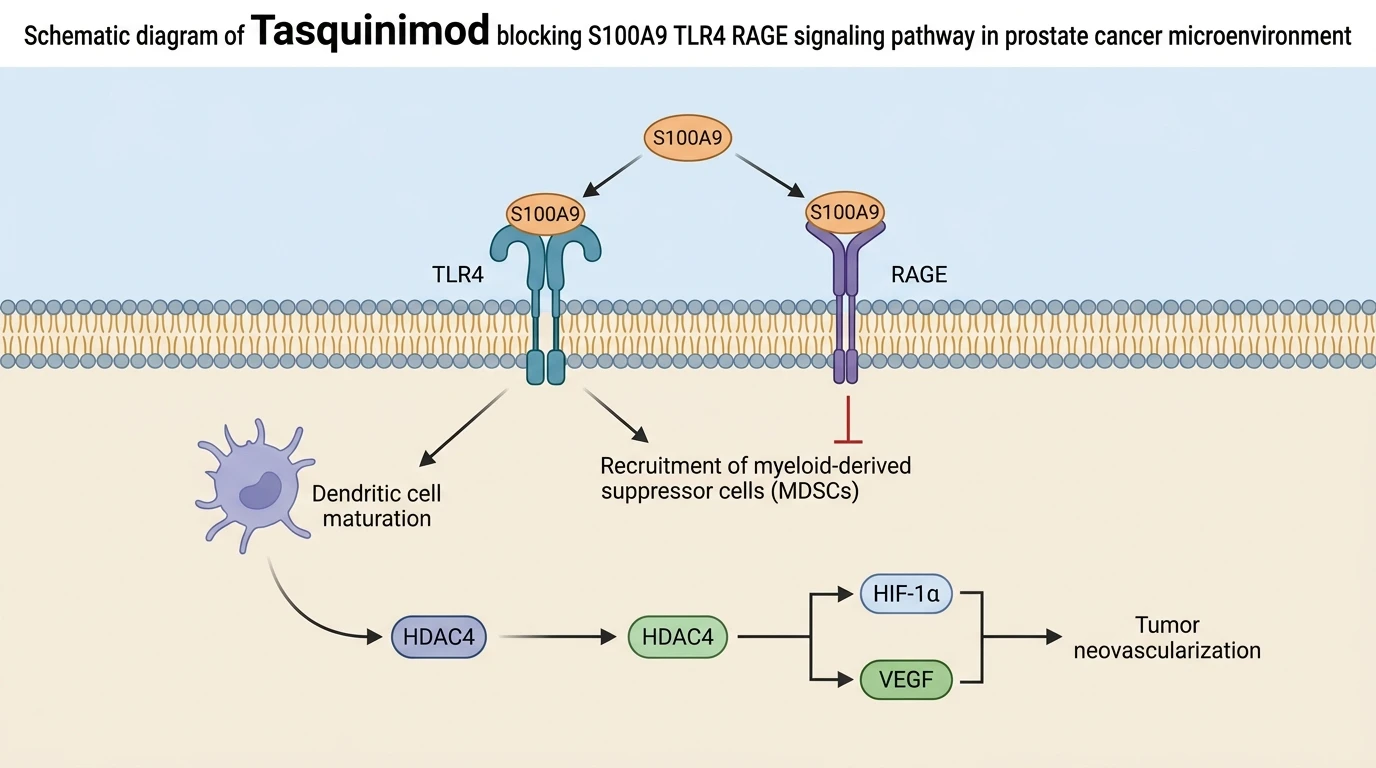
Tasquinimod is an oral drug that targets S100A9 and modulates HDAC4 signaling. By preventing S100A9 binding to TLR4 and RAGE receptors, it suppresses myeloid-derived suppressor cell (MDSC) recruitment and restores immune activity in the tumor microenvironment. Simultaneously, HDAC4 modulation downregulates HIF-1α and VEGF transcription, inhibiting tumor angiogenesis. This dual immunomodulatory and anti-angiogenic action extends progression-free survival in metastatic castration-resistant prostate cancer.
Suppression of S100A9 Dimerization Prevents MDSC Infiltration
In vitro binding assays indicate that Tasquinimod binds S100A9 with high affinity in a zinc-dependent manner. This interaction locks S100A9 into a conformation that precludes binding to extracellular TLR4 and RAGE domains. In syngeneic mouse tumor models, S100A9 blockade attenuated the systemic expansion of CD11b+Gr1+ myeloid-derived suppressor cells. Myeloid accumulation in splenic and intratumoral compartments decreased within 72 hours of administration. Consequently, CD8+ T-cell suppression eased. Local dendritic cell populations re-established expression of MHC class II and CD86 surface markers. These phenotypic shifts confirm that target engagement alters local paracrine signaling.
HDAC4 Inhibition Attenuates Hypoxia-Induced VEGF Expression
Beyond cell-surface receptor modulation, the Tasquinimod HDAC modulator alters nuclear histone deacetylase activity. HDAC4 controls the transcriptional stability of HIF-1α under hypoxic stress. In cultured prostate carcinoma cells, drug treatment accelerated HIF-1α polyubiquitination and proteasomal degradation. Downstream transcription of VEGF-A dropped significantly. Endothelial cell tube formation assays showed reduced branching length at nanomolar drug concentrations. Microvessel density in harvested xenograft tissues decreased by more than 40% relative to vehicle-treated controls. Vessel normalization was accompanied by reduced interstitial fluid pressure within the core tumor mass.
Extension of Progression-Free Survival in Castration-Resistant Models
Translational studies in clinical-stage mCRPC cohorts validate these preclinical findings. In randomized phase III trials, oral dosing yielded a statistically significant prolongation of median progression-free survival. Radiographic progression hazards decreased noticeably in patients receiving continuous therapy. Safety profiles revealed manageable toxicities, predominantly grade 1–2 fatigue and gastrointestinal events. Circulating cytokine monitoring showed persistent downregulation of serum S100A9 levels during active treatment. These clinical observations confirm that combined immunomodulatory and anti-angiogenic targeted inhibition disrupts key survival pathways in advanced prostate malignancies.