ORY-1001 from Selleck Inhibits LSD1 Covalently in Hematologic and Solid Tumors
Copy code to add this image to your page
Targeting epigenetic machinery through selective enzyme inhibition represents a primary strategy in reversing transcriptional silencing in transformed cells. Lysine-specific demethylase 1 (LSD1, also designated KDM1A) functions as a flavin adenine dinucleotide (FAD)-dependent amine oxidase that specifically removes mono- and di-methyl groups from histone H3 lysine 4 (H3K4) and lysine 9 (H3K9). In aberrant physiological states—most prominently acute myeloid leukemia (AML) and neuroendocrine malignancies—LSD1 over-expression maintains blocked cellular differentiation by suppressing myeloid lineage-specific gene programs. Ladademstat (ORY-1001) Dihydrochloride operates as an exceptionally potent, orally bioavailable, irreversible inhibitor of LSD1, exhibiting an in vitro biochemical IC50 of 18 nM.
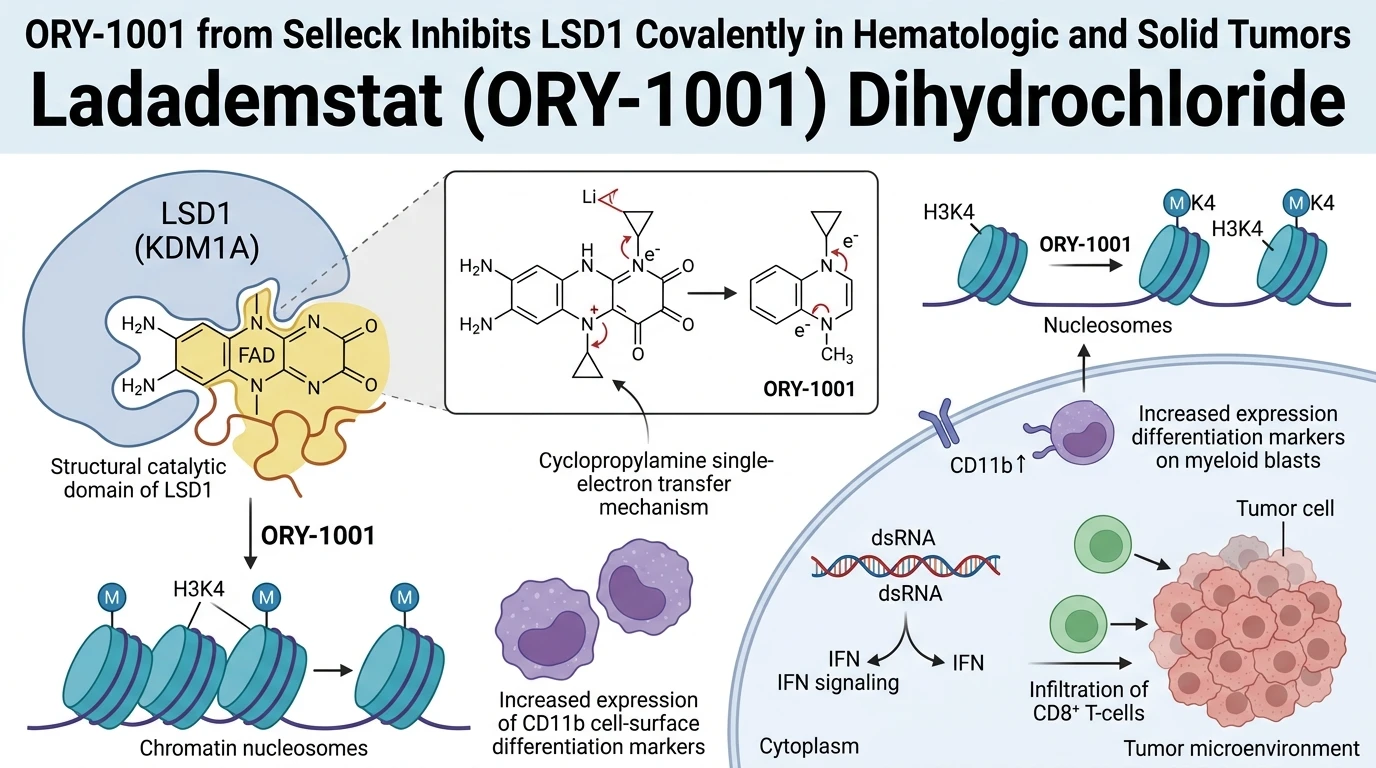
The molecular mechanism of Ladademstat (ORY-1001) Dihydrochloride relies on a single-electron transfer reaction targeting the prosthetic FAD group within the LSD1 catalytic domain. Upon entry into the active site cavity, the cyclopropylamine core of the small molecule undergoes single-electron oxidation mediated by FAD. This radical generation leads to rapid ring opening and the covalent attachment of the inhibitor fragment to the N5 position of the flavin cofactor. Covalent modification of FAD permanently disables the redox cycling capability of KDM1A. The binding kinetics demonstrate notable selectivity; Ladademstat displays over 1,000-fold selectivity for LSD1 relative to related monoamine oxidases MAO-A and MAO-B. This selectivity margin prevents off-target hypertensive crises associated with central and peripheral MAO inhibition.
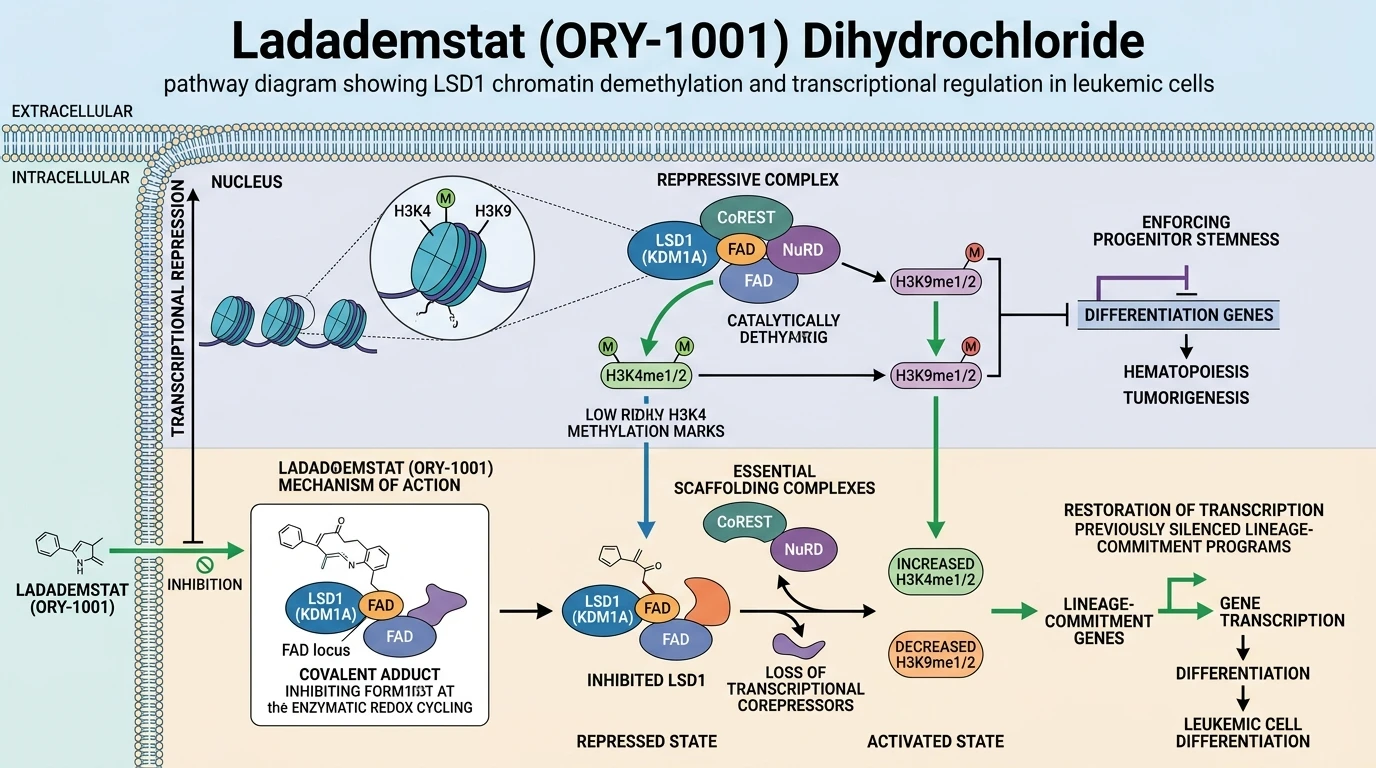
In cellular contexts, ORY-1001 from Selleck exhibits sub-nanomolar potency, disrupting the non-enzymatic scaffolding interaction between LSD1 and the transcriptional repressor growth factor independence 1B (GFI1B) or CoREST. Disassembly of this corepressor complex releases chromatin silencing at promoter regions of differentiation-driver genes. In MLL-rearranged AML models, exposure to sub-nanomolar concentrations triggers rapid transcriptional activation of the cell surface marker CD11b. Consequently, blasts undergo morphological maturation into mature granulocyte- and monocyte-like cells. Clonogenic assay observations demonstrate profound suppression of self-renewal capacity, forcing leukemic stem populations into irreversible terminal differentiation pathways.
Beyond hematologic lineage conversion, preclinical evaluation reveals potent activity across solid neuroendocrine neoplasms, including small-cell lung cancer (SCLC). SCLC cell lines characterized by NOTCH silencing and high ASCL1 expression show pronounced sensitivity to LSD1 blockade. Pharmacological intervention destabilizes the transcriptional networks sustaining neuroendocrine identity. Furthermore, combining LSD1 inhibition with immune checkpoint blockade yields enhanced anti-tumor activity. In syngeneic melanoma models, co-administration of Ladademstat (ORY-1001) Dihydrochloride with an anti-PD1 monoclonal antibody significantly augments tumor growth inhibition compared to monotherapy. Mechanistic analyses indicate that LSD1 inhibition reactivates silenced endogenous retroviruses (ERVs), driving a viral mimicry response that heightens double-stranded RNA sensing and major histocompatibility complex (MHC) class I antigen presentation within the tumor microenvironment. Early-phase clinical investigations confirm target engagement and pharmacodynamic activity in patients with relapsed or refractory AML and advanced SCLC.
Pharmacological Dynamics and Translational Anti-Tumor Efficacy
Copy code to add this image to your page
Ladademstat (ORY-1001) Dihydrochloride acts via single-electron transfer to form an irreversible covalent adduct with the N5 atom of the prosthetic FAD cofactor in LSD1 (KDM1A). This permanently blocks demethylation of H3K4me1/2 and H3K9me1/2, disrupting CoREST/GFI1B transcriptional corepressor complexes. Consequently, silenced differentiation pathways are reactivated in MLL-translocated leukemic cells, causing CD11b elevation and loss of clonogenicity. Furthermore, derepression of endogenous retroviruses triggers interferon responses and MHC-I expression, enhancing efficacy when combined with anti-PD1 checkpoint inhibitors.
Irreversible FAD Modification Drives Sub-Nanomolar Myeloid Differentiation
Covalent engagement of the FAD cofactor permanently disables LSD1 demethylase activity. Downstream transcriptional repression ceases rapidly. At sub-nanomolar concentrations, ORY-1001 from Selleck induces robust expression of CD11b across MLL-translocated leukemic blasts. Differentiation markers rise within 48 hours of exposure. This phenotypic shift coincides with a loss of clonogenic self-renewal. In patient-derived xenograft assays, daily oral administration suppresses circulating blast counts without systemic myelosuppression. The selectivity over MAO isoforms prevents off-target pressor responses.
Viral Mimicry Induction Enhances Checkpoint Immunotherapy Response
LSD1 inhibition restores transcription of silenced endogenous retroviral elements. Double-stranded RNA intermediates accumulate in the cytoplasm. Host pattern recognition receptors detect these nucleic acids, triggering type I interferon signaling. In syngeneic melanoma models, treatment with ORY-1001 from Selleck increases intratumoral CD8+ T-cell infiltration. Antigen presentation increases markedly. Combining LSD1 inactivation with anti-PD1 therapy achieves superior tumor regression compared to checkpoint monotherapy alone.
Clinical Characterization Across Hematologic and Solid Malignancies
Phase 1 and 2 clinical evaluation confirms predictable pharmacokinetic and pharmacodynamic profiles. Plasma exposures correlate directly with target occupancy in peripheral blood mononuclear cells. In patients with relapsed AML, oral dosing yields sustained CD11b upregulation. SCLC and neuroendocrine tumor cohorts demonstrate manageable safety profiles and preliminary signs of single-agent efficacy. Observations across early-stage trials highlight the potential of targeting chromatin-modifying enzymes in neuroendocrine lineage plasticity.