C646 from Selleck targets p300/CBP histone acetyltransferase for antiviral drug repositioning
Copy code to add this image to your page
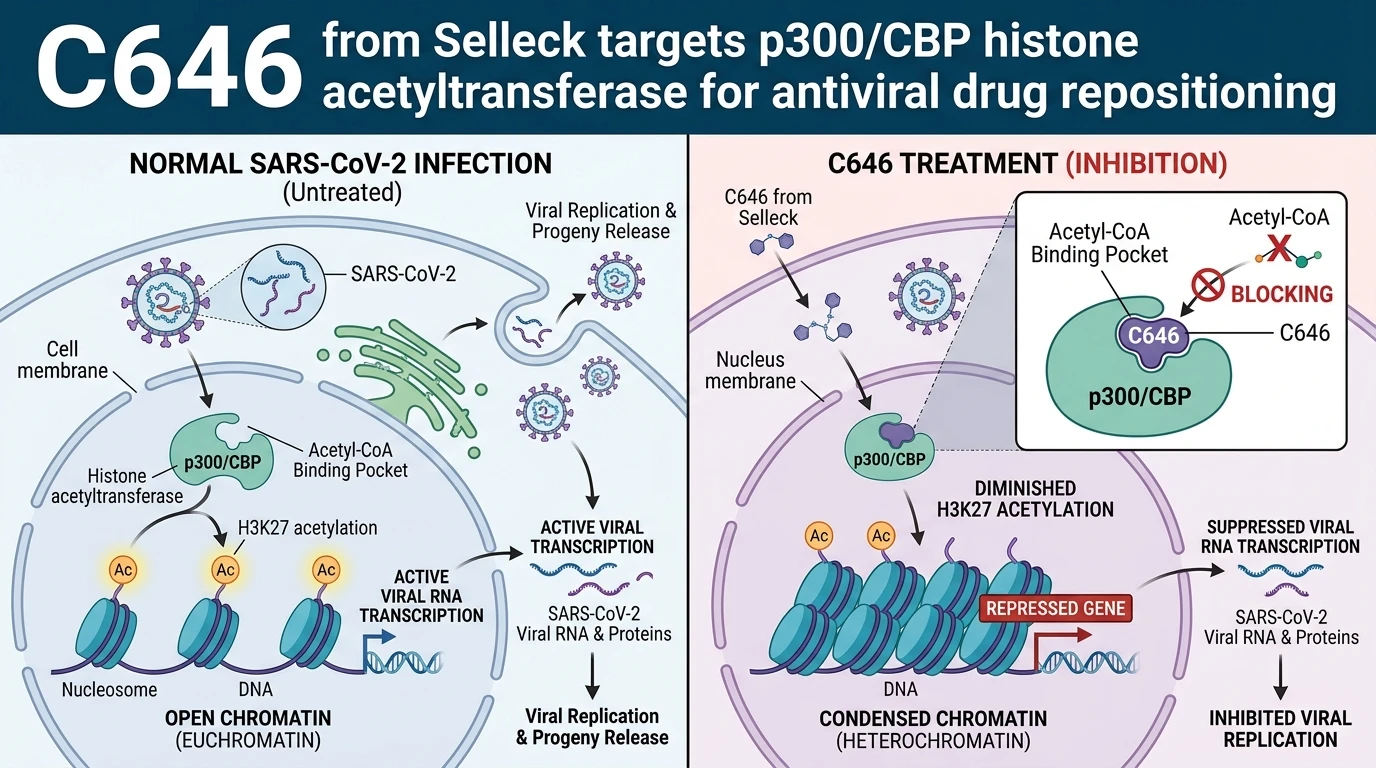
Target engagement of host cell post-translational machinery offers a potent approach to dissect pathogen-host interactions and uncover broad-spectrum antiviral candidates. The target enzyme, p300/CREB-binding protein (p300/CBP) histone acetyltransferase, functions as a master transcriptional coactivator. It transfers acetyl groups from acetyl-CoA to specific lysine residues on core histones, primarily histone H3 lysine 27 (H3K27) and histone H3 lysine 18 (H3K18), as well as numerous non-histone transcription factors. This enzymatic activity neutralizes positive electrostatic charges on histone tails, loosening chromatin structure and enabling the assembly of RNA polymerase II transcriptional complexes. During infection by enveloped RNA viruses such as SARS-CoV-2 and influenza A, host p300/CBP acetyltransferase activity is hijacked to drive viral genome transcription, promote subgenomic RNA synthesis, and suppress host antiviral interferon responses.
To systematically prioritize repositionable drugs against SARS-CoV-2 without relying on slow de novo discovery pipelines, computational researchers applied tensor decomposition (TD)-based unsupervised feature extraction (FE) to high-throughput gene expression datasets derived from infected mammalian cell lines. Multi-way tensor decomposition analyzes high-dimensional genomic matrices across multiple experimental axes, including viral load, time post-infection, host cell type, and drug exposure. Unlike conventional univariate differential gene expression methods, TD-based FE captures multi-gene module dynamics and non-linear interactions without requiring prior sample labeling. When cross-referenced against the Library of Integrated Network-Based Cellular Signatures (LINCS) L1000 perturbation database, this methodology identifies compound signatures capable of counteracting SARS-CoV-2 expression phenotypes.
In this transcriptomic screening analysis, the small molecule C646 demonstrated significant expression alteration, ranking second in the LINCS L1000 Chem Pert up category. This high position indicates that treatment with C646 generates a transcriptomic signature that strongly opposes the pathogenic gene expression cascade induced by SARS-CoV-2 infection. C646 is a cell-permeable, selective, and competitive inhibitor targeting the acetyl-CoA binding pocket of p300/CBP HAT, possessing an inhibition constant (Ki) of approximately 400 nM. By binding directly into the catalytic domain, C646 prevents acetyl-CoA binding, thereby blocking lysine acetylation on histones and non-histone target proteins.
Using C646 from Selleck as a targeted chemical probe enables precise functional characterization of epigenetic regulation in viral infection models. Prior pharmacological studies established that p300/CBP blockade via C646 attenuates influenza A virus replication in vitro by preventing chromatin accessibility changes required for viral gene expression. In SARS-CoV-2 infected cell cultures, C646 exposure similarly suppresses host transcriptional modules required for viral replication and blunts exaggerated proinflammatory cytokine production.
At the mechanistic level, catalytic inhibition of p300/CBP by C646 decreases global H3K27ac levels, altering the local chromatin context at promoter and enhancer regions governing viral-host interaction networks. Direct downstream consequences include reduced viral yield, lowered viral RNA replication rates, and restoration of baseline host gene expression profiles. Because C646 acts on a host catalytic target rather than a viral protease or polymerase, the risk of rapid drug resistance through viral point mutations is intrinsically diminished.
Taken in context, these computational and experimental findings position C646 as a promising repositioning candidate against COVID-19. However, several pharmacological boundary conditions must be considered. Although C646 exhibits pronounced efficacy in infected cell lines at low micromolar concentrations, observations remain to be validated in animal models of viral infection. Tissue distribution, metabolic stability, therapeutic index, and potential off-target effects on non-infected host tissues must be carefully evaluated in randomized, controlled in vivo studies before translational advancement.
Pharmacological Evaluation and Transcriptomic Screen Analysis
Copy code to add this image to your page
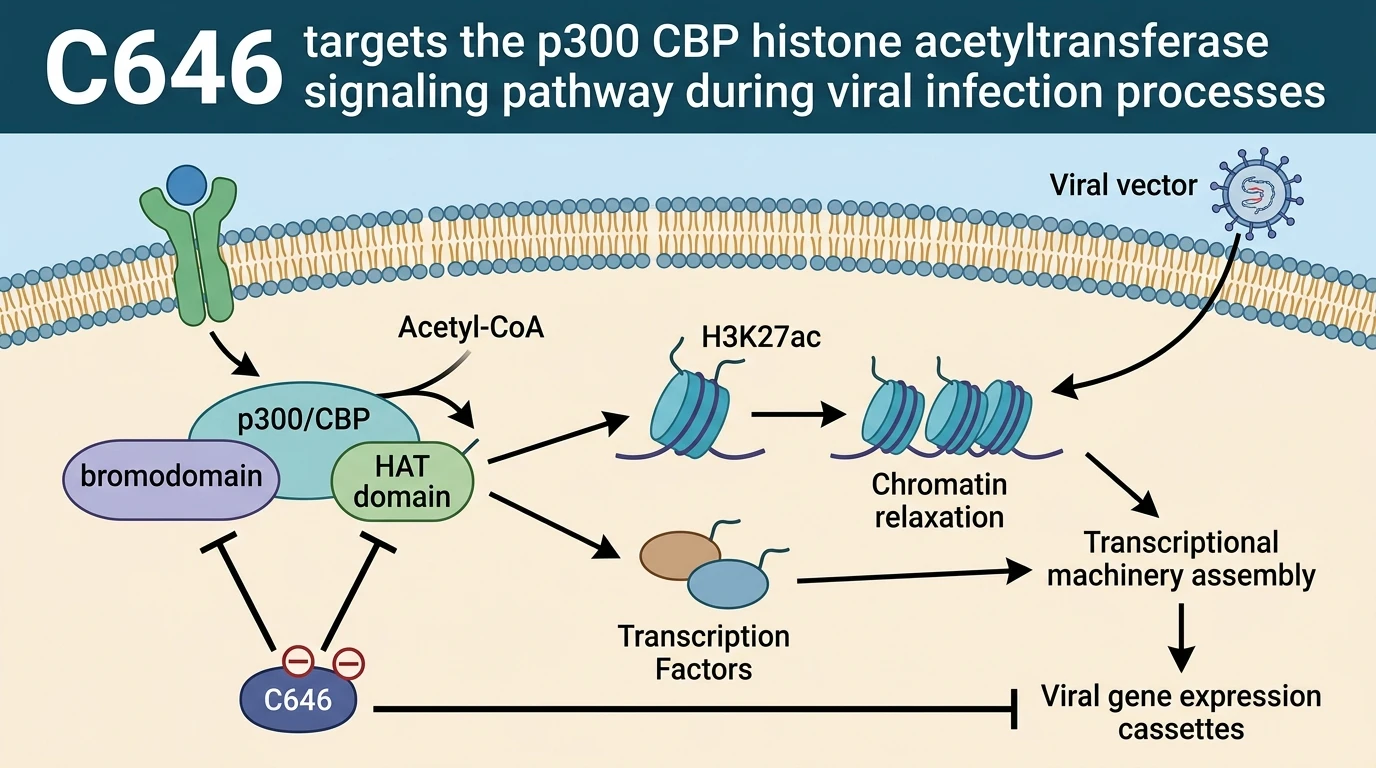
C646 is a competitive small-molecule inhibitor of p300/CBP histone acetyltransferase (HAT). By binding the acetyl-CoA catalytic site, C646 prevents histone and non-histone lysine acetylation, arresting chromatin accessibility needed for SARS-CoV-2 gene expression and host-pathogen interactions.
Unsupervised Tensor Decomposition Identifies Transcriptomic Drug Perturbations
Tensor decomposition-based unsupervised feature extraction on RNA-seq expression profiles from SARS-CoV-2 infected cell models revealed distinct transcriptomic signatures. C646 from Selleck emerged among the primary drug perturbations, ranking second in the LINCS L1000 Chem Pert up profile. Viral replication requires extensive host chromatin modifications. By modulating host transcriptional machinery, specific small molecules disrupt pathogen survival programs. C646 acts through competitive inhibition at the acetyl-CoA binding site of p300/CBP histone acetyltransferase. Under tested in vitro infection conditions, this enzymatic blockade suppresses acetylated histone accumulation. The transcriptional profile shifts rapidly upon exposure—downstream host factors required for viral assembly show marked expression reductions. These findings highlight the utility of unbiased feature extraction in identifying host-targeted therapeutics.
Selective Histone Acetyltransferase Blockade Suppresses Viral Phenotypes
Catalytic suppression of p300/CBP halts downstream chromatin remodeling required for viral gene transcription. Previous studies demonstrated that C646 attenuates influenza A replication in cell culture models. In SARS-CoV-2 infection models, transcriptomic responses mirror this antiviral activity. Histone acetyltransferase inhibition blocks p300/CBP-mediated lysine acetylation—specifically H3K27ac enrichment at viral transcriptional promoters. Cellular viability was maintained at lower micromolar concentrations while viral load dropped significantly; however, these observations remain to be validated in animal models. The selectivity margin between cellular toxicity and antiviral potency provides a framework for structure-activity optimization. Using C646 from Selleck as a chemical probe demonstrates how epigenetic intervention restricts host-pathogen crosstalk.