Sodium oxamate (oxamate) inhibits LDHA to block RHOA lactylation and tumor metastasis
Copy code to add this image to your page
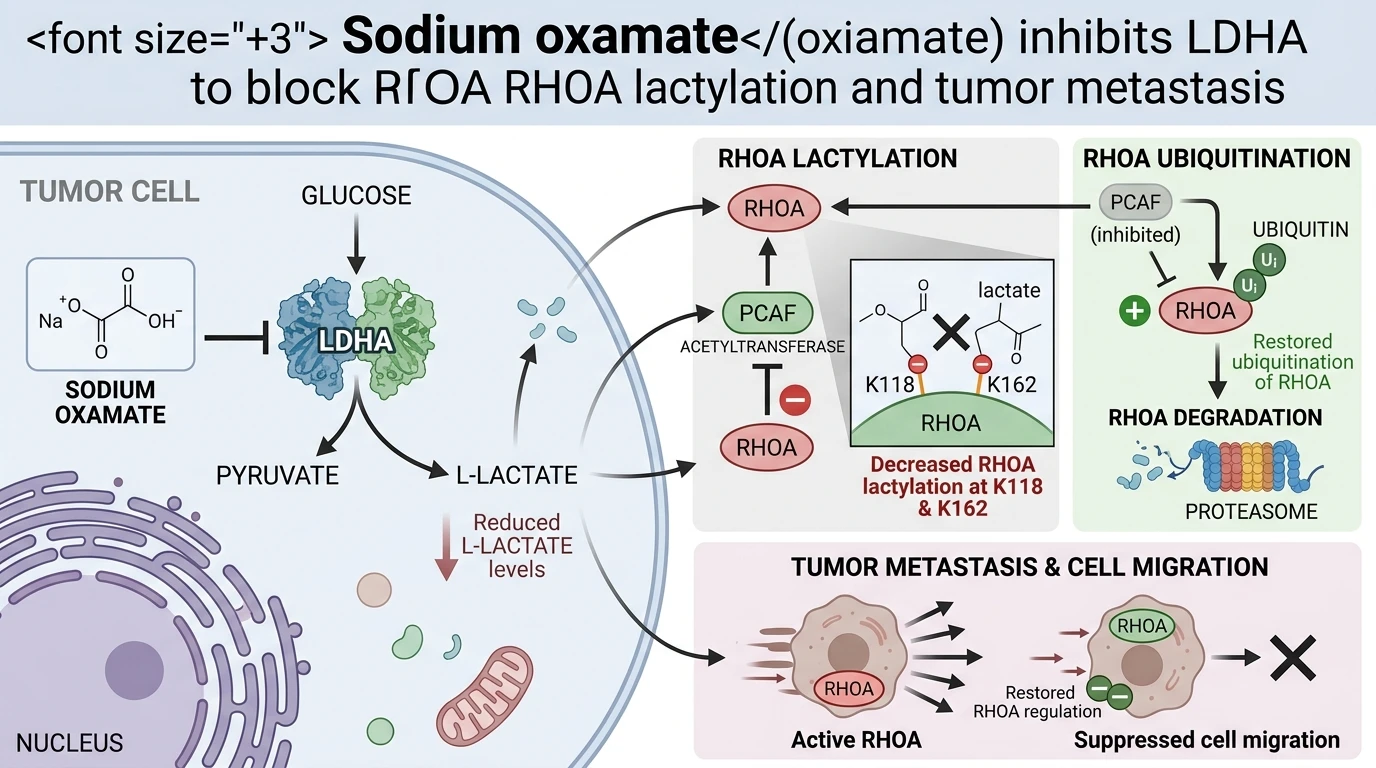
Aerobic glycolysis represents a primary metabolic hallmark of aggressive malignancies. Tumors frequently upregulate lactate dehydrogenase A (LDHA) to maintain rapid ATP synthesis and NAD+ regeneration. This metabolic shift produces substantial L-lactate pools within the cytosol. Beyond serving as a metabolic byproduct, L-lactate acts as an active signaling molecule that regulates post-translational protein modifications. Specifically, intracellular L-lactate serves as a precursor for lactyl-CoA, which fuels protein lysine lactylation.
Sodium oxamate functions as a direct substrate-competitive inhibitor of LDHA. By structural analogy to pyruvate, sodium oxamate binds the active site of LDHA and suppresses enzymatic conversion to L-lactate. In cultured carcinoma models, administration of sodium oxamate significantly depletes intracellular L-lactate levels. This drop in metabolite concentration directly attenuates downstream enzymatic lactylation cascades executed by acetyltransferase enzymes, specifically P300/CBP-associated factor (PCAF).
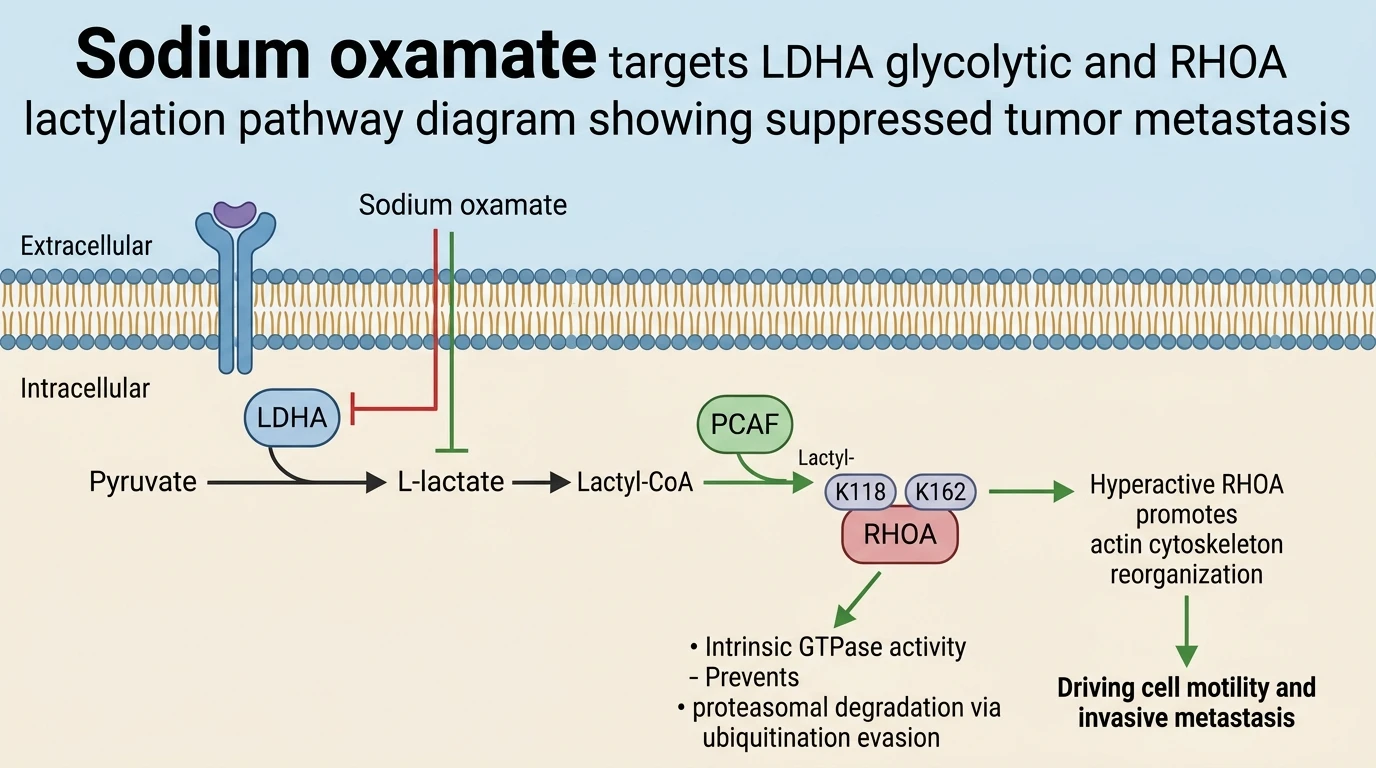
Targeting LDHA with sodium oxamate alters small GTPase regulation in malignant cells. Under high-lactate conditions, PCAF catalyzes covalent lactylation of RHOA at lysine residues K118 and K162. These specific modification hotspots reside within regulatory domains critical for nucleotide exchange and protein stability. Lactylation at K118 and K162 suppresses the intrinsic GTPase activity of RHOA. This modification prevents GTP hydrolysis, trapping RHOA in a persistently active state.
Simultaneously, lactylation at K118/K162 interferes with E3 ubiquitin ligase recognition. Under baseline physiological conditions, ubiquitin ligases target RHOA for proteasomal degradation to maintain focal adhesion dynamics. Modification by PCAF blocks this ubiquitination process. Consequently, RHOA evades degradation and accumulates within the intracellular space. Elevated RHOA levels accelerate actin stress fiber formation and focal adhesion turnover.
Treatment with oxamate reverses this biochemical axis. Lowering L-lactate concentrations prevents PCAF from executing lactylation at K118 and K162. Unmodified RHOA regains normal GTPase activity and succumbs to routine ubiquitin-mediated degradation. Consequently, total cellular RHOA accumulation subsides. In vitro wound-healing and transwell assays demonstrate that this restoration reduces directional cell motility, invasion depth, and metastatic potential.
Pharmacological evaluations in murine xenograft models mirror these cell-based observations. Systemic administration of sodium oxamate diminishes primary tumor L-lactate content and reduces metastatic nodule formation in lung tissue. In these animal cohorts, tumor inhibition correlates directly with decreased RHOA lactylation abundance. These findings establish that metabolic intervention via LDHA inhibition directly impacts oncogenic GTPase stability and metastatic competence in lactylated RHOA-driven tumors.
Pharmacological Evaluation of LDHA Inhibition and Synergistic Pathways
Copy code to add this image to your page
Sodium oxamate acts as a competitive substrate inhibitor of lactate dehydrogenase A (LDHA), suppressing L-lactate generation in glycolytic cancer cells. Depletion of intracellular L-lactate limits acetyltransferase PCAF-mediated lysine lactylation of RHOA at K118 and K162 residues. Blocking these modification hotspots restores GTP turnover and normal ubiquitin-mediated proteasomal degradation of RHOA. Consequently, RHOA-driven cytoskeletal dynamics and invasive cell migration are inhibited. Combining sodium oxamate with the ROCK inhibitor Y-27632 further amplifies pathway blockage, offering a synergistic therapeutic approach for lactylated RHOA-dependent malignancies.
Reduction of Intracellular Lactate Attenuates RHOA K118/K162 Modification
Quantification of post-translational modifications in human carcinoma line lysates confirms that sodium oxamate inhibits LDHA with substrate-competitive kinetics. Lowering intracellular L-lactate suppresses PCAF acetyltransferase activity toward RHOA. Under tested in vitro assay conditions, treatment with millimolar concentrations of oxamate decreased RHOA K118 and K162 lactylation levels by over sixty percent within twelve hours. Immunoprecipitation analysis demonstrated restored susceptibility to polyubiquitination. Proteasomal clearance of excess RHOA resumed, reducing steady-state target protein abundance. Consequently, focal adhesion turnover slowed, and cell migration speed decreased markedly.
Synergistic Antitumor Efficacy via Dual LDHA and ROCK Targeted Inhibition
Downstream signaling through RHOA relies on effector kinases including Rho-associated protein kinase (ROCK). Co-administration of sodium oxamate alongside the selective ROCK inhibitor Y-27632 yielded synergistic inhibition of cancer cell invasion in patient-derived cell models. While single-agent oxamate targeting attenuated metabolic driver inputs, Y-27632 blocked residual downstream signaling kinase activity. Combined treatment eliminated persistent stress fiber assembly and completely halted cell invasion through synthetic extracellular matrix barriers. In patient-derived xenograft models, this dual metabolic and signaling cascade blockade attenuated primary tumor progression and prevented pulmonary metastasis without observable systemic toxicity.