B/B Homodimerizer from Selleck AP20187 Induces FKBP-Caspase 8 Apoptosis
Copy code to add this image to your page
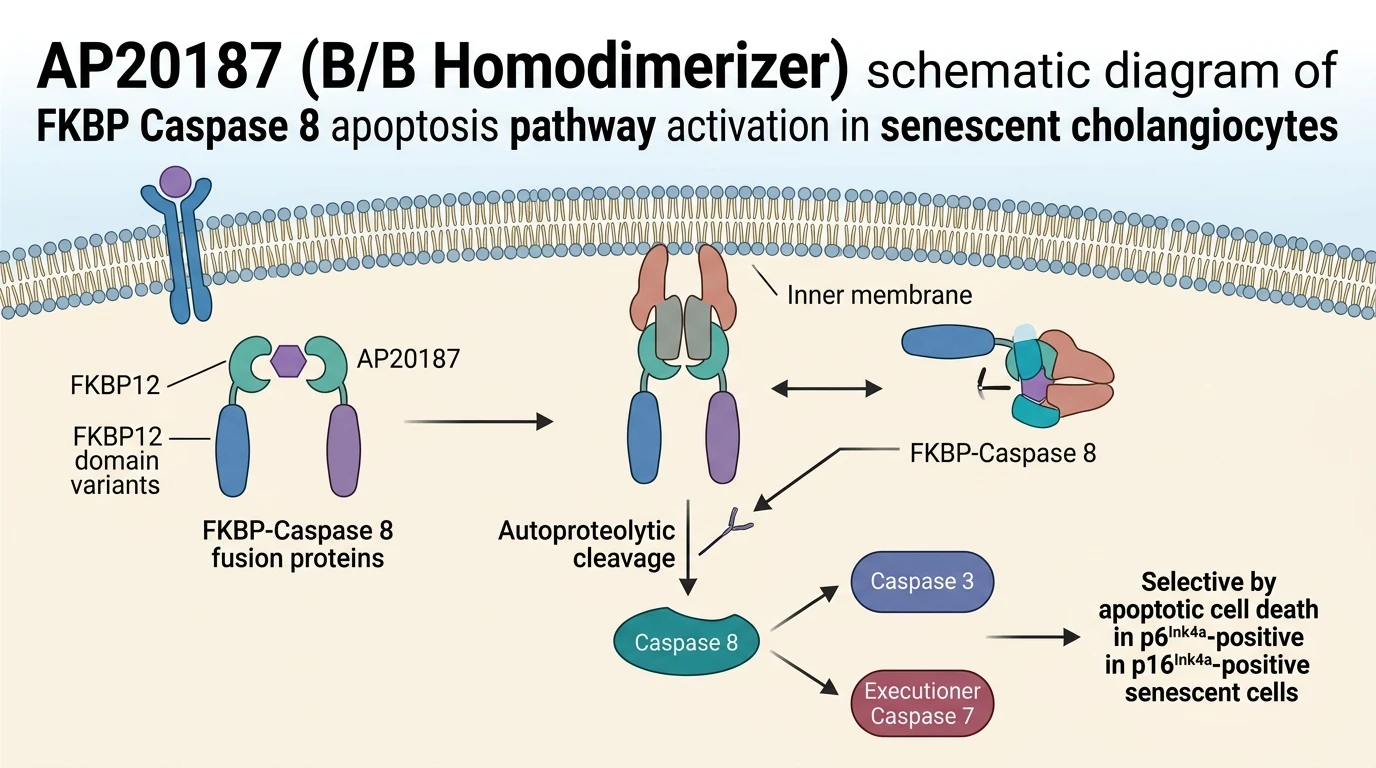
AP20187 is a bivalent chemical inducer of dimerization engineered to engage synthetic FK506-binding protein (FKBP) fusion constructs with high selectivity. Structurally, AP20187 contains two identical ligand moieties joined by a rigid central spacer. This symmetrical architecture enables simultaneous binding to two F36V mutant FKBP modules. In transgenic suicide gene strategies, FKBP domains are fused directly to the catalytic domain of human Caspase 8. Under basal conditions, the FKBP-Caspase 8 (FKBP-Casp8) chimera exists as an inactive monomer within the cytoplasm or anchored to cellular membranes. Endogenous dimerization signals are absent, maintaining low zymogen activity.
Exogenous administration of AP20187 forces rapid protein proximity. Bivalent ligand engagement cross-links two FKBP-Casp8 monomers into an active homodimeric complex. Enforced homodimerization induces a conformational transition within the Caspase 8 catalytic domain. This spatial realignment facilitates autoproteolytic cleavage at conserved aspartate residues between the large and small subunits. Cleavage stabilizes the active heterotetramer. Activated Caspase 8 subsequently cleaves downstream executioner caspases, including Caspase 3 and Caspase 7. This proteolytic cascade triggers execution of cell-extrinsic apoptotic pathways. In benchmark studies published in FEBS Letters signaling studies, chemical dimerizers demonstrate minimal cross-reactivity with endogenous wild-type FKBP12 at sub-nanomolar concentrations.
The targeted clearance of senescent cells, termed senolytic therapy, relies on selective ablation of cells exhibiting chronic cell-cycle arrest and persistent inflammatory secretory phenotypes. Senescent cells accumulate in chronically injured tissues, including the liver parenchyma during cholestatic injury. Primary sclerosing cholangitis (PSC) is characterized by progressive peribiliary inflammation, stricture formation, and severe fibrosis. Pathologically, damaged cholangiocytes enter a state of senescent arrest driven by elevated expression of p16Ink4a and p21Cip1/Waf1. These senescent cholangiocytes secrete a complex mixture of pro-inflammatory cytokines, chemokines, and matrix metalloproteinases, collectively known as the senescence-associated secretory phenotype (SASP). SASP signaling amplifies localized immune cell recruitment and activates hepatic stellate cells, sustaining chronic fibrogenesis.
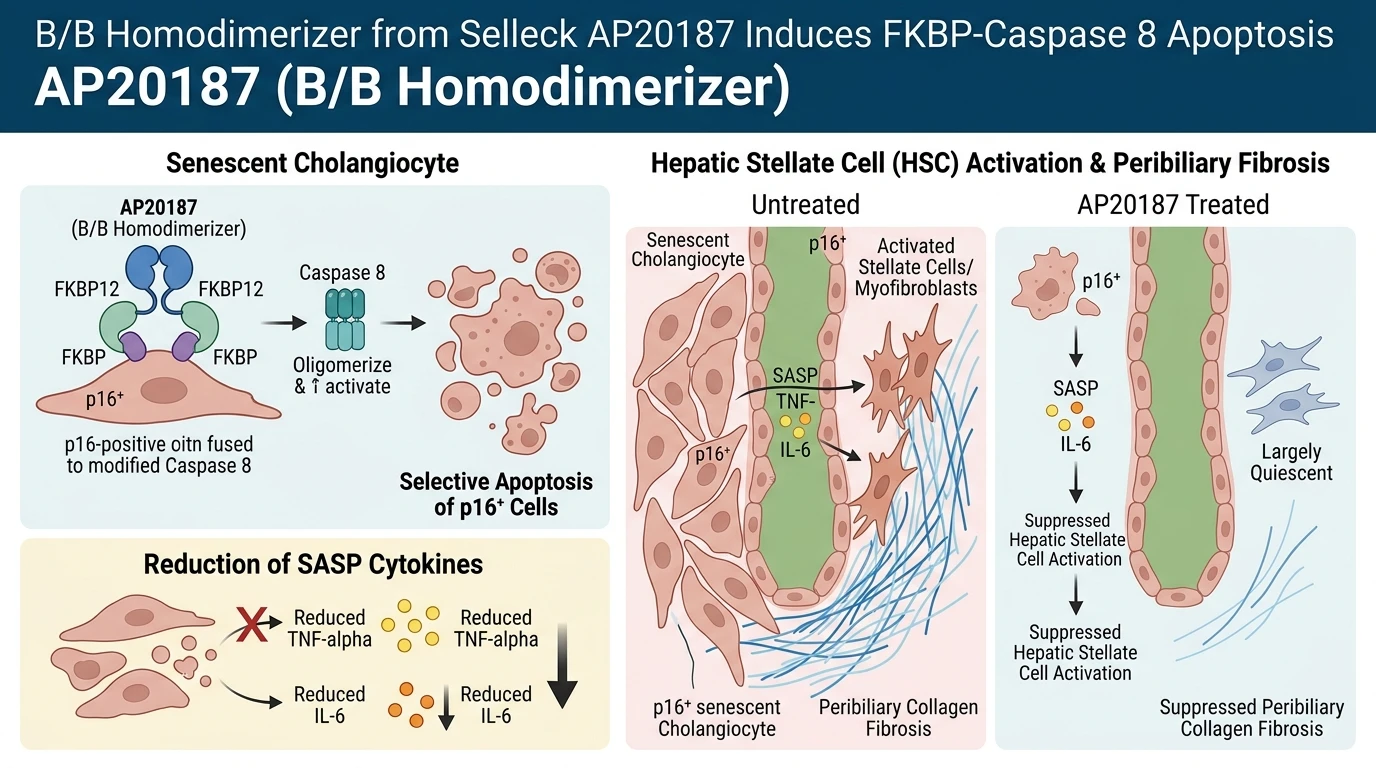
To evaluate targeted senolysis in cholestatic liver injury, researchers utilize transgenic model systems such as the ATTACxMdr2-/- mouse model. In this setup, the p16Ink4a promoter drives expression of the FKBP-Casp8 suicide cassette selectively in senescent cells. Application of AP20187 allows precise, temporal control over senescent cholangiocyte elimination. Ligand exposure triggers selective apoptosis in p16-positive cells without affecting non-senescent neighboring hepatocytes or cholangiocytes. This targeted approach isolates the specific contribution of senescent cells to chronic liver injury.
Pharmacological characterization of AP20187 confirms sub-nanomolar binding affinity (Kd < 0.1 nM) for the FKBP(F36V) mutant domain. The steric bulk of the phenyl-substituted valine residue at position 36 prevents binding of endogenous FKBP12 to AP20187, providing a selectivity margin exceeding 1000-fold over wild-type proteins. Consequently, AP20187 administration avoids systemic immunosuppressive toxicity typically associated with native FKBP ligands like tacrolimus or rapamycin. Controlled homodimerization yields rapid apoptotic kinetics, with Caspase 8 activation detectable within 30 minutes of ligand exposure in vitro. In vivo, AP20187 displays adequate tissue bioavailability and systemic exposure following parenteral administration, facilitating targeted senolytic studies in rodent models of liver disease.
Pharmacodynamic Profiling and Antifibrotic Efficacy in Cholestatic Models
Copy code to add this image to your page
AP20187 is a synthetic B/B homodimerizer that selectively binds FKBP(F36V) fusion proteins to induce proximity-dependent activation of membrane-anchored Caspase 8. In transgenic models of primary sclerosing cholangitis, AP20187 triggers targeted apoptosis of p16Ink4a-expressing senescent cholangiocytes. Selective elimination of these senescent cells lowers hepatic p16 and p21 expression, suppresses pro-inflammatory SASP cytokines (TNF-α, IL-1β, IL-6, MCP-1) by 40–60%, and attenuates peribiliary fibrosis by 50–60%, validating senolytic therapy for chronic cholestatic liver disease.
Targeted Senolysis Reduces Hepatic SASP Cytokine Expression
In the ATTACxMdr2-/- transgenic mouse model of primary sclerosing cholangitis, administration of AP20187 induced rapid clearance of p16Ink4a-expressing senescent cholangiocytes. Quantitative transcript and protein analyses demonstrated significant reductions in whole-liver senescence markers p16 and p21 following treatment. This selective ablation disrupted the persistent paracrine signaling loop maintained by senescent biliary epithelial cells. Levels of key senescence-associated secretory phenotype (SASP) pro-inflammatory cytokines—specifically TNF-α, IL-1β, IL-6, and MCP-1—decreased by 40% to 60% relative to vehicle-treated control animals. The reduction in cytokine production directly suppressed recruitment of infiltrating macrophages and neutrophils into the peribiliary portal tracts. Inflammatory signaling waned rapidly. These findings indicate that senescent cholangiocyte removal effectively dampens the chronic inflammatory microenvironment driving cholestatic liver damage.
Attenuation of Peribiliary Fibrosis and Paracrine Stellate Activation
Sustained SASP secretion by senescent cholangiocytes directly stimulates transdifferentiation of resident hepatic stellate cells into collagen-producing myofibroblasts. Treatment with the B/B Homodimerizer from Selleck significantly altered this fibrogenic axis in vivo. Hepatic scarring decreased noticeably. Morphometric evaluation of liver histology revealed an approximate 50% to 60% reduction in peribiliary hepatic fibrosis in AP20187-treated mice compared to controls. Collagen deposition around intrahepatic bile ducts was markedly attenuated as assessed by picrosirius red staining and hydroxyproline content assays. The reduction in parenchymal scarring correlated with decreased alpha-smooth muscle actin (α-SMA) expression in peribiliary regions. Crucially, neighboring non-senescent hepatocytes maintained normal regenerative capacity throughout the dosing regimen. These empirical observations demonstrate that targeted FKBP-Casp8 dimerization provides a potent intervention against progressive liver fibrosis.