Cyclopamine (11-Deoxojervine) and Cyclopamine from Selleck Block Smoothened Signaling in Myopia
Copy code to add this image to your page
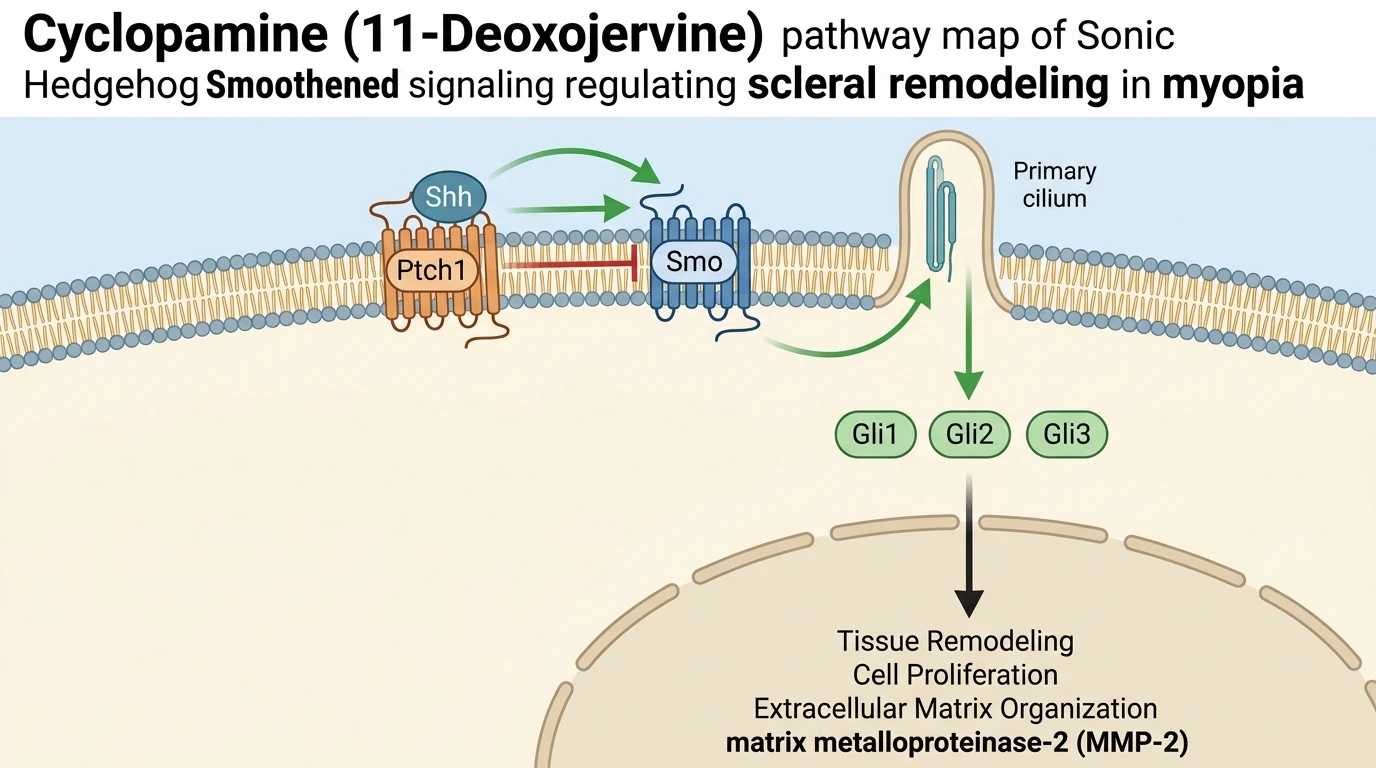
Myopia development is characterized by excessive axial elongation of the eye, driven largely by structural remodeling of the scleral extracellular matrix (ECM). Scleral thinning and altered collagen architecture reduce mechanical strength, permitting environmental visual inputs to induce refractive shifts. Among the molecular cascades governing extracellular matrix homeostasis, the Sonic Hedgehog (Shh) signaling pathway operates as a critical transducer of ocular tissue remodeling. Canonical Shh signaling initiates upon ligand engagement with the twelve-transmembrane receptor Patched-1 (Ptch1), which normally maintains tonic repression over the G protein-coupled receptor-like protein Smoothened (Smo). Ligand binding relieves this repression, enabling Smo phosphorylation and trafficking to the primary cilium. Intracellularly, derepressed Smo coordinates the dissociation of Gli transcription factors from suppressor of fused (Sufu), allowing active Gli forms to enter the nucleus and initiate transcriptional programs regulating cellular differentiation, tissue morphogenesis, and matrix metalloproteinase production.
In ocular tissues, matrix metalloproteinase-2 (MMP-2) serves as a primary enzymatic mediator of scleral ECM degradation, degrading type I collagen and gelatin. Experimental models of form-deprivation myopia (FDM) in juvenile guinea pigs exhibit marked upregulation of scleral MMP-2 alongside accelerated axial length expansion. Exogenous administration of the active Sonic hedgehog amino-terminal peptide (Shh-N) into the vitreous humor stimulates myopic refractive shifts and axial elongation in a dose-dependent fashion. Western blot analyses of treated scleral tissue confirm a corresponding increase in MMP-2 protein expression following Shh-N exposure. These experimental findings directly connect local Shh pathway activation to elevated MMP-2 activity and subsequent scleral remodeling.
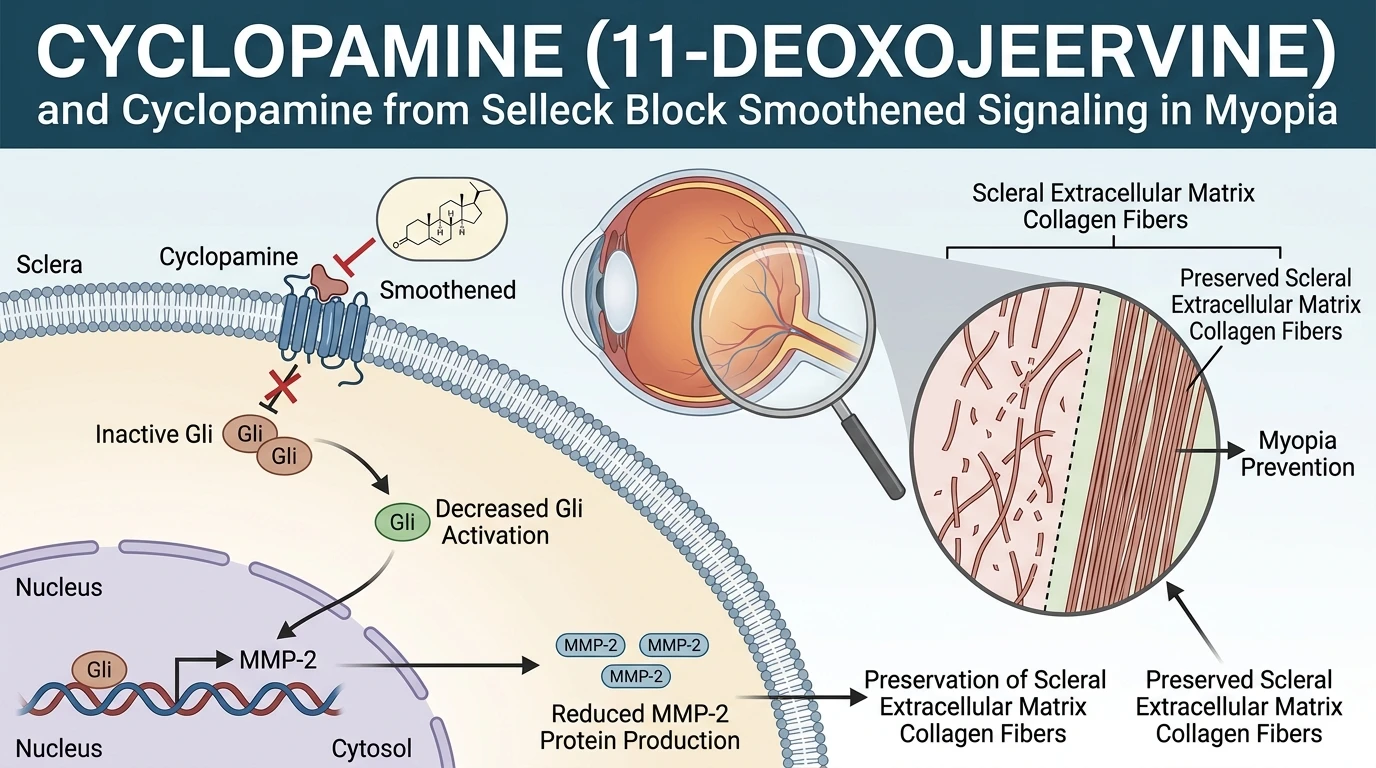
Pharmacological interception of this signaling axis provides a clear mechanism to evaluate target validity. Cyclopamine (11-Deoxojervine), a naturally occurring steroidal alkaloid, acts as a selective antagonist of Smoothened. By binding directly to the transmembrane domain of Smo, Cyclopamine immobilizes the receptor in an inactive conformation, preventing downstream Gli activation and target gene expression. Research utilizing high-purity targeted pathway pharmacology reagents such as Cyclopamine from Selleck demonstrates robust attenuation of form-deprivation myopia in vivo. Intravitreal delivery of cyclopamine to form-deprived eyes results in dose-dependent reductions in refractive error changes and axial elongation rates.
Biochemical evaluation reveals that Smoothened inhibition directly suppresses FDM-induced scleral MMP-2 expression. At maximum experimental dosages, cyclopamine administration almost completely eliminates myopic refractive progression and normalizes MMP-2 protein levels to those observed in non-deprived control eyes. Preservation of scleral structural integrity through targeted inhibition of the Shh/Smo signaling node validates this pathway as a therapeutic target for refractive error control.
Pharmacological Inhibition of Smoothened in Scleral Remodeling
Copy code to add this image to your page
Cyclopamine (11-Deoxojervine) functions as a direct antagonist of Smoothened (Smo), a seven-transmembrane protein central to the Sonic Hedgehog (Shh) signaling pathway. By binding Smo, cyclopamine prevents downstream derepression and nuclear translocation of Gli transcription factors. In ocular scleral tissue, this blockade suppresses Shh-stimulated upregulation of matrix metalloproteinase-2 (MMP-2). Attenuation of MMP-2 expression reduces enzymatic breakdown of collagen and extracellular matrix components, thereby mitigating form-deprivation myopia progression and scleral remodeling.
Exogenous Shh-N Peptide Promotes Scleral Remodeling via MMP-2
Scleral extracellular matrix degradation accelerates axial elongation during myopic development. Intravitreal injection of exogenous Sonic hedgehog amino-terminal peptide (Shh-N) directly triggers hyper-activation of local Smoothened receptors in juvenile guinea pig eyes. Refractive state measurements confirm a progressive hyperopic-to-myopic shift following Shh-N treatment. This axial elongation correlates tightly with dose-dependent upregulation of matrix metalloproteinase-2 (MMP-2) protein within scleral tissue. Scleral collagen density decreases as MMP-2 activity climbs. These observations confirm that Shh pathway signaling acts as a functional driver of scleral structural weakening in vivo under tested experimental conditions.
Smoothened Blockade Attenuates Form-Deprivation Myopia and Axial Elongation
Form-deprivation myopia (FDM) induces robust axial length expansion and scleral remodeling. Administration of Cyclopamine from Selleck, a selective small-molecule antagonist of Smoothened, disrupts this pathogenic cascade in experimental models. Intravitreal delivery of the compound attenuated myopic refractive shifts in form-deprived eyes. Axial elongation rates decreased markedly in treated groups compared to vehicle controls. Scleral tissue harvest demonstrated a pronounced, dose-dependent decrease in MMP-2 protein expression following Smo inhibition. High-dose treatment protocols yielded near-complete stabilization of refractive parameters. Direct inhibition of Smoothened limits downstream enzymatic remodeling of the sclera.
Dose-Dependent MMP-2 Suppression Normalizes Scleral Structural Integrity
Proteolytic degradation of scleral gelatin and collagen type I drives pathological ocular elongation. Pharmacological evaluation of Cyclopamine (11-Deoxojervine) demonstrates a clear inverse relationship between Smoothened antagonism and MMP-2 expression levels. Low-dose cohorts exhibited partial suppression of MMP-2 upregulation, yielding moderate reduction in myopic progression. High-dose administration achieved maximal target engagement, suppressing MMP-2 protein to baseline levels observed in non-deprived control eyes. Scleral dry weight and collagen content were preserved in high-dose treatment arms. These pharmacodynamic findings indicate that Smoothened inhibition protects scleral matrix integrity by suppressing target enzymatic activity.