ABT-494 (Upadacitinib) Selectively Inhibits JAK1 Signaling in Autoimmune and Inflammatory Disease
Copy code to add this image to your page
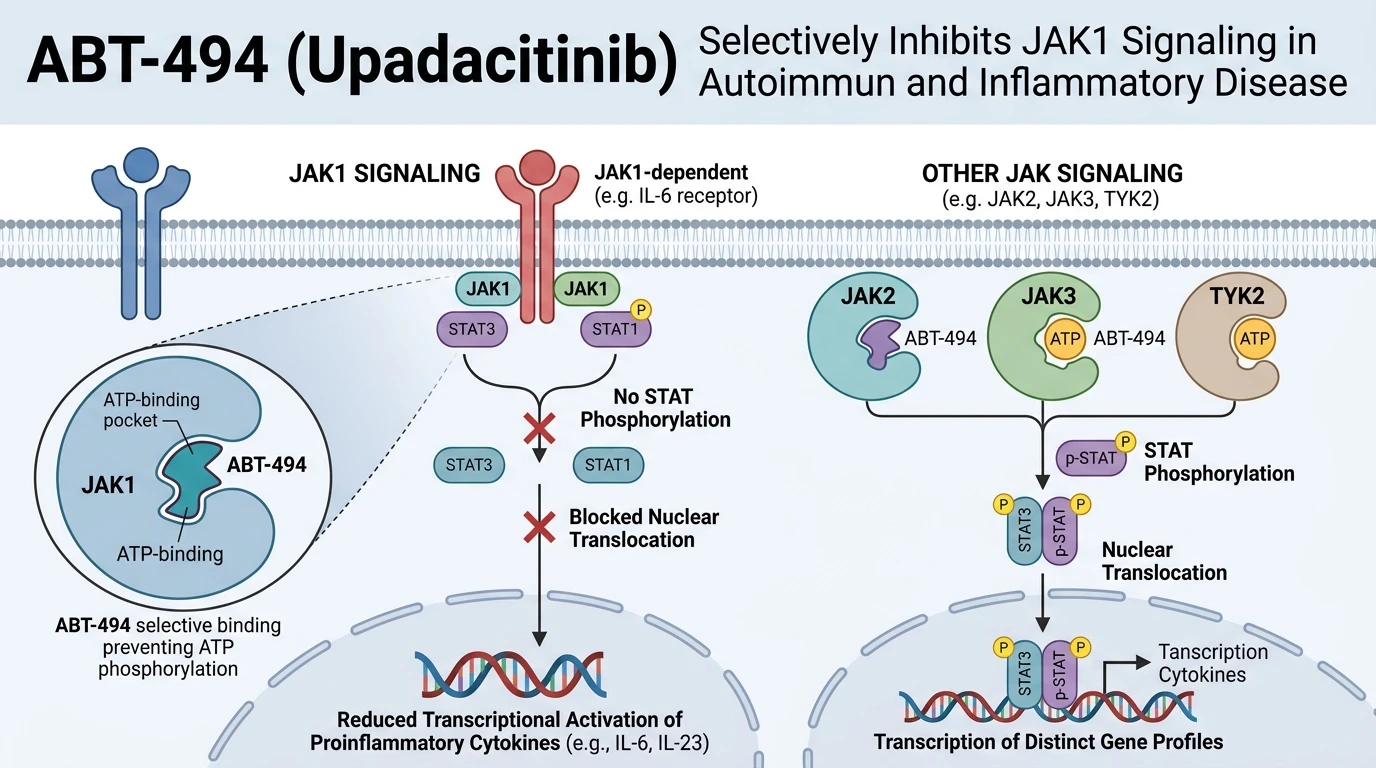
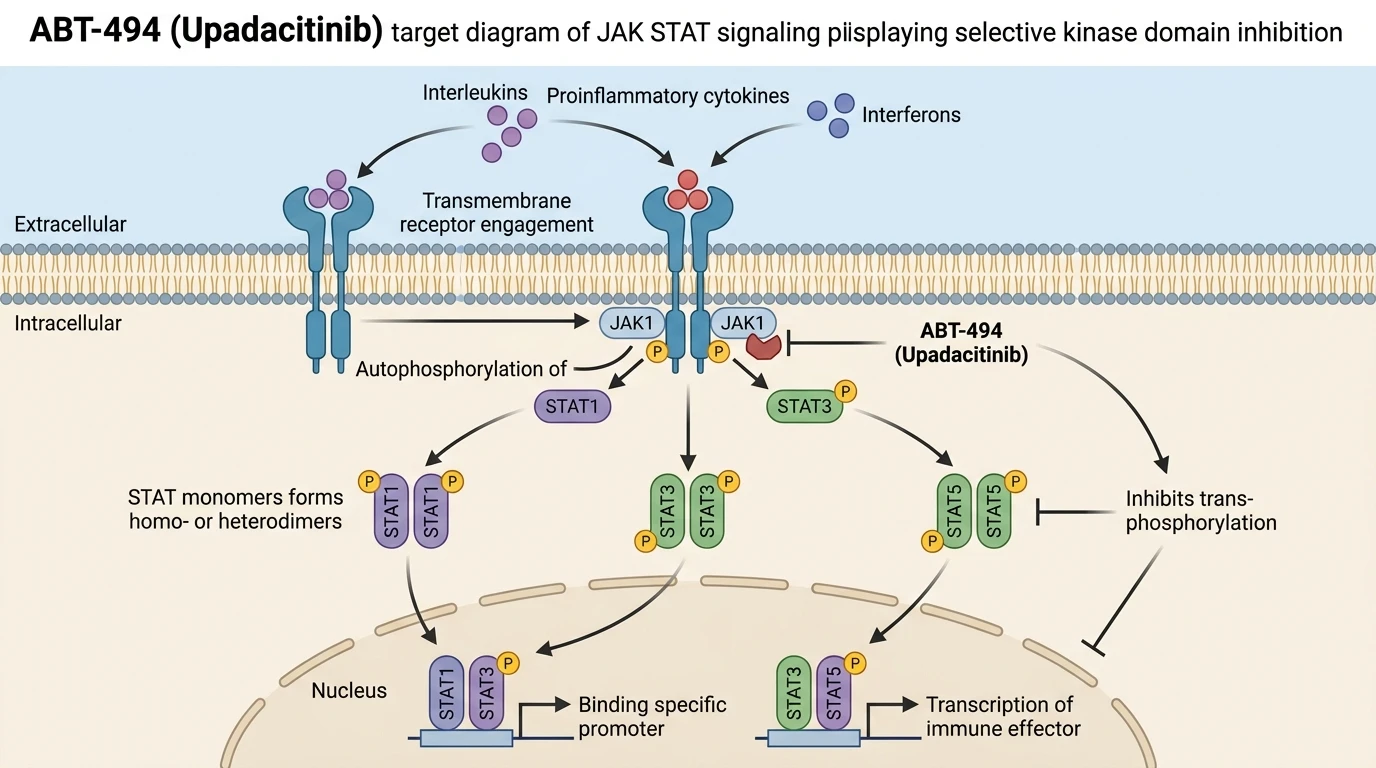
The Janus kinase (JAK) family of intracellular non-receptor tyrosine kinases—comprising JAK1, JAK2, JAK3, and TYK2—functions as a pivotal transducer of cytokine-mediated signaling pathways. Cytokine binding to cell surface receptors induces receptor dimerization, bringing associated JAK enzymes into close proximity to enable trans-phosphorylation. Activated JAKs subsequently phosphorylate specific tyrosine residues on the receptor tails, creating docking sites for Src homology 2 domain-containing STAT transcription factors. Upon recruitment, STAT proteins undergo phosphorylation, dissociate from the receptor complex, and assemble into homo- or heterodimers. These dimers translocate into the cell nucleus, binding target promoter regions to modulate the transcription of gene networks involved in immune cell proliferation, differentiation, and inflammatory amplification. Targeting this pathway with small-molecule inhibitors has reshaped therapeutic strategies for chronic autoimmune conditions. ABT-494 (Upadacitinib) was engineered as an oral, ATP-competitive inhibitor designed with enhanced selectivity for JAK1 over other family members, particularly JAK2 and JAK3. High enzyme selectivity is crucial. Unselective inhibition of JAK2 can disrupt erythropoietin signaling, resulting in severe anemia and cytopenias, whereas JAK3 blockade compromises common gamma-chain cytokine signaling essential for lymphocyte survival. In biochemical enzymatic assays, ABT-494 (Upadacitinib) exhibits significantly higher potency against JAK1 relative to JAK2 and JAK3, thereby minimizing off-target haematological and immunosuppressive toxicities under therapeutic concentration ranges. The structural architecture of ABT-494 (Upadacitinib) allows high-affinity interactions within the ATP-binding pocket of the active JAK1 kinase domain. Hydrogen bonding with hinge region residues stabilizes the inhibitor in an orientation that effectively blocks ATP binding and downstream trans-phosphorylation. Inhibition of JAK1 selectively suppresses signaling cascades downstream of proinflammatory cytokines, including interleukin-6, interferon-gamma, and interleukin-21. As detailed in cytokine signaling investigations published across autophagy and cellular immunology literature, downstream inhibition prevents STAT1 and STAT3 phosphorylation, arresting transcriptional activation of target proinflammatory genes. In preclinical cellular assays and human ex vivo whole-blood systems, the compound demonstrated potent inhibition of IL-6-induced STAT3 phosphorylation and IL-2-induced STAT5 phosphorylation, while showing markedly lower potency against thrombopoietin-induced STAT2 and JAK2 dependent pathways. Cellular selectivity ratios confirm a wide safety window, protecting homeostatic hematopoiesis while dampening pathologic autoimmune signaling. The therapeutic potential of ABT-494 (Upadacitinib) extends across moderate-to-severe rheumatoid arthritis, psoriatic arthritis, atopic dermatitis, and ulcerative colitis, where JAK1-dependent cytokines drive clinical manifestations. By preserving signaling pathways mediated by non-JAK1 complexes, the inhibitor achieves therapeutic efficacy while dampening adverse effect profiles typical of pan-JAK inhibitors.
Pharmacokinetic Characterization and Metabolic Profile Analysis
Copy code to add this image to your page
ABT-494 (Upadacitinib) is an oral, ATP-competitive Janus kinase 1 (JAK1) inhibitor exhibiting high selectivity over JAK2, JAK3, and TYK2. By binding the catalytic domain of JAK1, the compound blocks cytokine-stimulated trans-phosphorylation and prevents activation of STAT transcription factors. This inhibition diminishes downstream transcription of inflammatory mediators, suppressing systemic immune responses. The extended-release formulation provides stable systemic exposure with a 9–14 hour half-life, supporting once-daily clinical administration across autoimmune indications.
Dose-Proportional Pharmacokinetics of Extended-Release Formulation
The oral administration of ABT-494 (Upadacitinib) in an extended-release formulation delivers predictable, dose-proportional systemic exposure. Plasma concentrations peak smoothly, avoiding elevated peak-to-trough fluctuations that correlate with transient off-target inhibition. The terminal elimination half-life spans 9 to 14 hours. This kinetic window supports a standard once-daily dosing regimen of 15 mg. Population pharmacokinetic analyses indicate that intrinsic patient factors do not dictate dosage alterations. Systemic clearance remains consistent across age groups, sex, body weight variations, and racial backgrounds. Furthermore, mild, moderate, or severe renal impairment does not produce clinically meaningful shifts in drug exposure. Hepatic clearance pathways similarly tolerate mild-to-moderate hepatic impairment without requiring initial dose adjustments. Cellular exposure metrics remain stabilized within therapeutic ranges across broad patient sub-populations.
CYP3A4-Mediated Metabolic Pathways and Drug Interaction Potential
Metabolic clearance of ABT-494 (Upadacitinib) relies primarily on CYP3A4-mediated hepatic oxidation, with minor contributions from CYP2D6. Coadministration with strong CYP3A4 inhibitors, such as ketoconazole, increases systemic exposure by approximately 75%. Conversely, strong CYP3A4 inducers like rifampicin decrease AUC values by roughly 50%. Clinical monitoring is indicated when coadministering potent CYP3A4 modulators. However, coadministration with conventional synthetic disease-modifying antirheumatic drugs, including methotrexate, produces no relevant changes in pharmacokinetics. Statins, oral contraceptives, and biological therapies display zero significant drug-drug interaction potential. The predictable pharmacokinetic performance of ABT-494 (Upadacitinib) reinforces stable 15 mg once-daily administration in clinical management of rheumatoid arthritis.