SBE-β-CD chemical encapsulation enhances lipophilic GABAA receptor agonist solubilization and safety profile
Copy code to add this image to your page
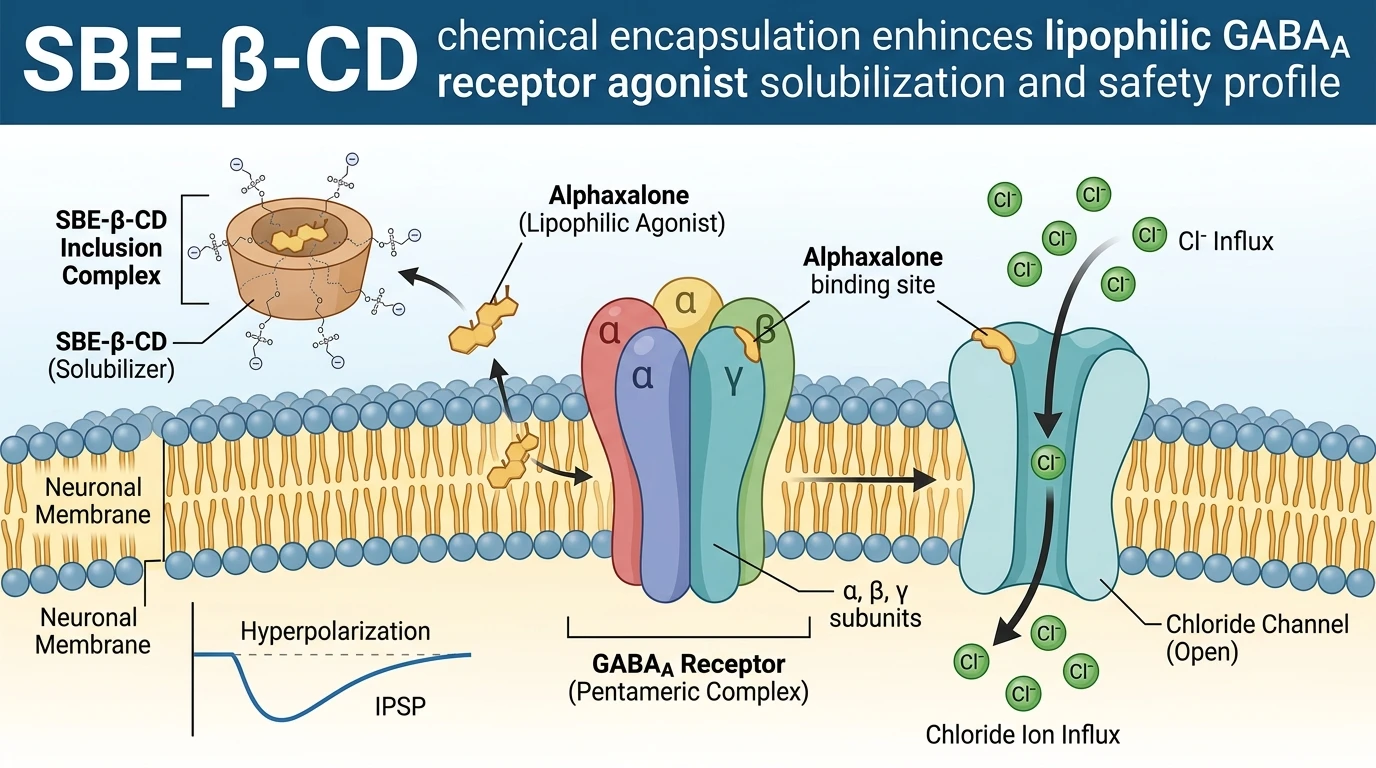
Hydrophobic neurosteroid anesthetics present substantial formulation challenges due to their negligible aqueous solubility at physiological pH. Alphaxalone, a synthetic 3α-hydroxy-5α-pregnane neurosteroid, acts as a potent positive allosteric modulator of the GABAA receptor complex. By binding to specific transmembrane sites on the α and β subunits, alphaxalone increases chloride channel opening frequency and duration. This hyperpolarizes postsynaptic neurons in the central nervous system, producing rapid hypnotic and anesthetic responses. However, traditional clinical delivery of alphaxalone historically relied on polyethoxylated castor oil (Cremophor EL), an emulsifying surfactant associated with significant adverse reactions. Cremophor EL induces histamine release, severe anaphylactoid responses, peripheral neuropathies, and vascular irritation at the injection site. These solvent-induced toxicities severely restricted the therapeutic application of neurosteroid anesthetics in human and veterinary medicine.
To bypass surfactant-related toxicities, modified cyclodextrins have emerged as sophisticated excipient architectures. Polymeric cyclodextrin derivative 7-sulfobutylether-β-cyclodextrin, commonly designated as SBECD or SBE-β-CD, contains a hydrophilic outer shell with negatively charged sulfobutylether groups surrounding a lipophilic central cavity. The hydrophobic interior of the SBE-β-CD chemical complex non-covalently accommodates the steroidal core of alphaxalone through hydrophobic interactions and van der Waals forces. This host-guest inclusion process dynamically equilibrates in aqueous solution, yielding a dramatic increase in apparent water solubility without altering the intrinsic pharmacodynamic activity or chemical structure of the active pharmaceutical ingredient.
Upon intravenous bolus administration, the inclusion complex dissociates rapidly due to concentration-driven equilibrium shifts and binding competition with serum lipids and albumin. Free alphaxalone rapidly crosses the blood-brain barrier to target central GABAA receptors. Preclinical electrophysiological measurements in isolated cortical neurons demonstrate that alphaxalone-SBE-β-CD formulations retain full intrinsic potency at allosteric modulatory sites, exhibiting sub-micromolar half-maximal effective concentration values (EC50 ≈ 0.2–0.5 µM). Comparative hemodynamics show that SBE-β-CD formulations eliminate the histamine-mediated hypotension and severe cardiorespiratory depression previously observed with castor oil-based vehicles.
Biocompatibility evaluations reveal that the anionic sulfobutylether modifications lower membrane-disrupting toxicity relative to parent β-cyclodextrin. Parent β-cyclodextrin preferentially extracts cholesterol from cell membranes, leading to hemolysis and localized nephrotoxicity upon parenteral administration. The charge repulsion provided by the sulfobutyl groups prevents excessive membrane lipid extraction, allowing SBE-β-CD to be cleared rapidly by renal glomerular filtration with minimal tubular damage. SBE-β-CD provides an optimal pharmacokinetic vehicle that combines high solubilization capacity with an exceptionally benign safety profile, rendering it ideal for rapid-onset neurosteroid anesthesia.
Pharmacological Optimization and GABAA Receptor Engagement Mechanisms
Copy code to add this image to your page
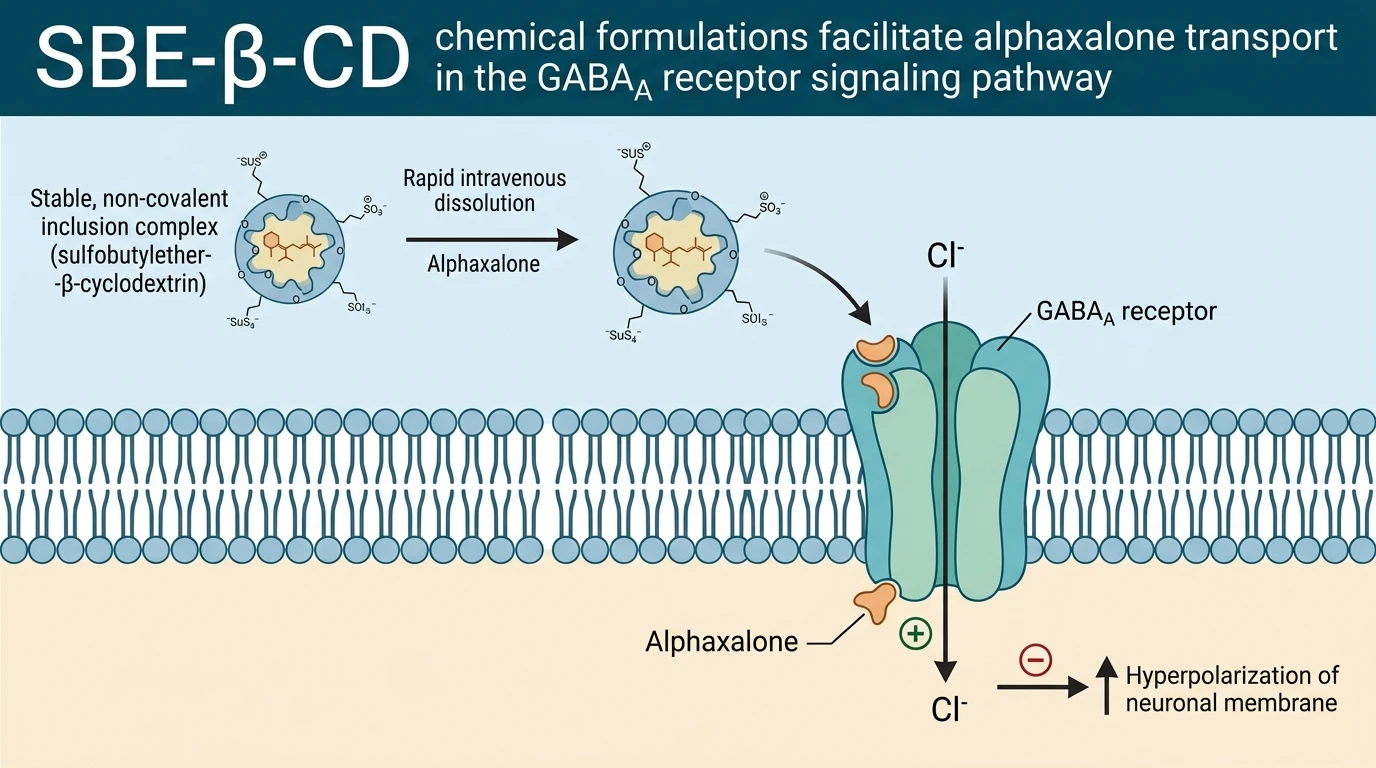
SBE-β-CD acts as a functional solubilizing host vehicle by forming dynamic inclusion complexes with hydrophobic neurosteroids like alphaxalone. This non-covalent encapsulation increases aqueous drug solubility over several orders of magnitude without altering receptor affinity. Upon intravenous administration, rapid dilution and equilibrium shift release free alphaxalone to bind postsynaptic GABAA receptors, promoting chloride ion influx and hyperpolarizing neuronal membranes. SBE-β-CD prevents histamine release, injection pain, and surfactant-induced cardiorespiratory depression.
Aqueous Complexation Prevents Histamine Mediated Solvent Toxicity
Formulation safety remains critical during intravenous anesthetic delivery. SBECD host-guest complexes eliminate the requirement for toxic organic co-solvents or castor oil derivatives. In canine and feline models, SBE-β-CD chemical excipient vehicles produced no measurable histamine liberation or anaphylactoid responses upon rapid intravenous injection. Blood pressure remained stable across therapeutic dose ranges. Local vascular tolerance assays indicated an absence of phlebitis or injection pain. The chemical modification shields cellular membranes from non-specific surfactant disruption. Consequently, the therapeutic window expands considerably relative to older formulations.
Targeted Modulation of Ionotropic Central GABAA Receptors
Rapid release kinetics govern the therapeutic onset of cyclodextrin-encapsulated neurosteroid drugs. Free alphaxalone equilibrates within seconds following parenteral administration. Whole-cell patch-clamp recordings confirm selective binding to α1β2γ2 GABAA receptor subtypes. Potentiation of GABA-evoked chloride currents occurs without direct receptor desensitization at clinical concentrations. Rapid brain distribution induces prompt hypnosis. Recovery kinetics parallel rapid hepatic clearance without tissue accumulation. Thus, SBE-β-CD complexation preserves central receptor pharmacokinetics while mitigating vehicle toxicity.