Tubacin Selective HDAC6 Inhibition Regulates Aggresomal Clearance of Misfolded CFTR Mutants
Copy code to add this image to your page
Cystic fibrosis stems from mutations in the gene encoding the cystic fibrosis transmembrane conductance regulator (CFTR) anion channel. Among these genetic alterations, transmembrane-domain missense variants—including G85E, E92K, L1077P, and M1101K—cause severe protein misfolding, defective cellular processing, and premature intracellular degradation. Defining the exact cellular clearance mechanisms governing these specific mutant proteins is essential for designing targeted molecular therapies capable of restoring surface channel expression.
Intracellular proteostasis networks evaluate CFTR folding through distinct cellular degradation systems. In mammalian expression models, misfolded CFTR variants undergo clearance primarily through endoplasmic reticulum-associated degradation (ERAD) mediated by the ubiquitin-proteasome system. Pharmacological intervention with the proteasome inhibitor MG-132 markedly reduces the turnover rate of G85E, E92K, L1077P, and M1101K polypeptides. This suppression confirms proteasomal cleavage as the primary elimination pathway under basal physiological conditions. However, when proteasomal machinery approaches saturation, secondary clearance cascades are engaged to process persistent non-native species.
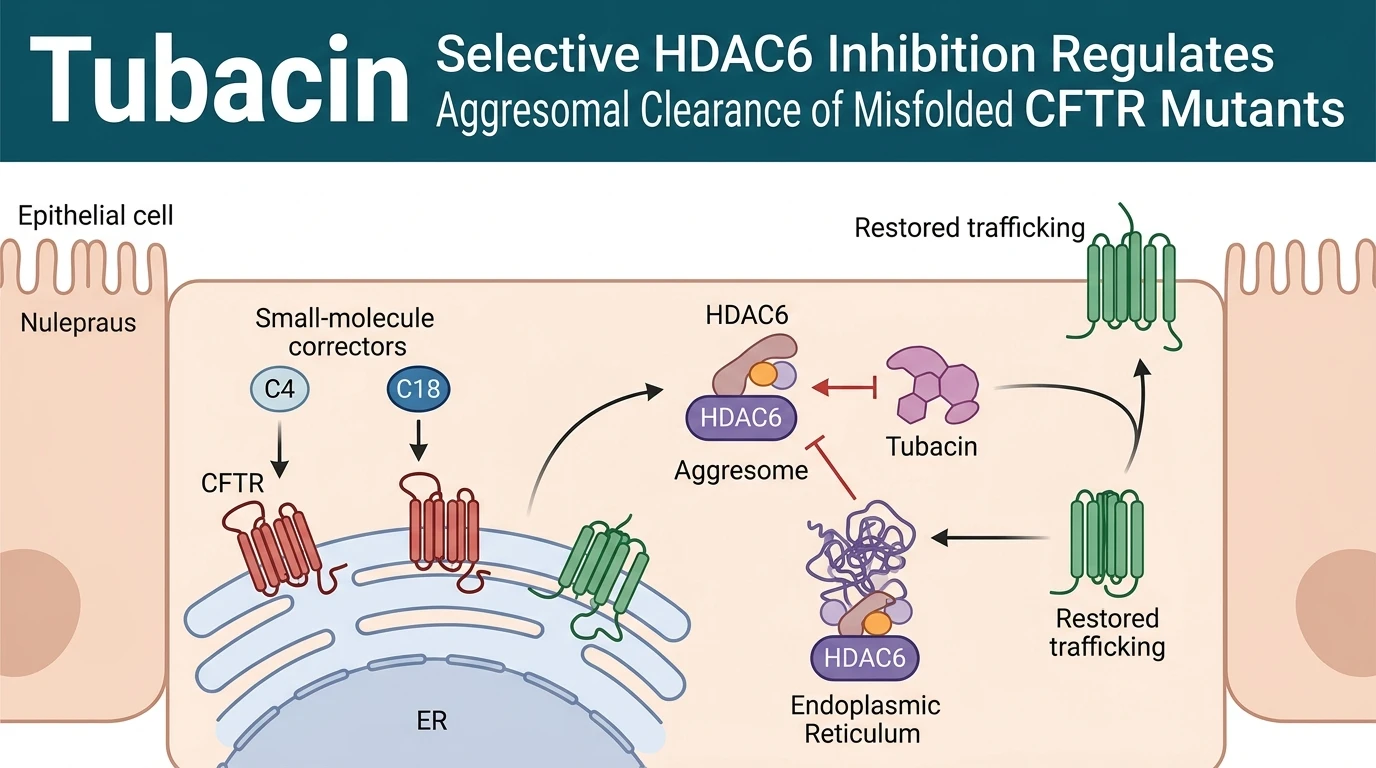
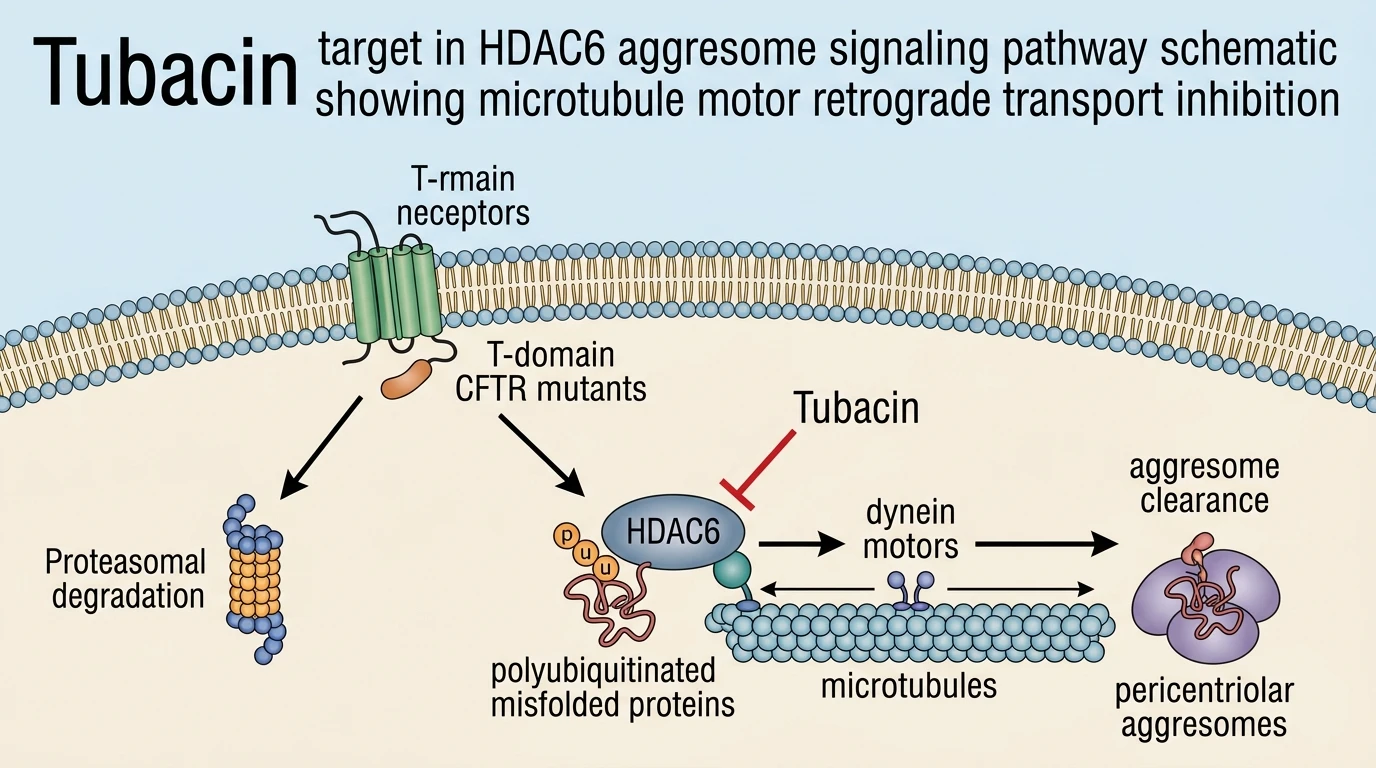
Aggresome formation serves as an alternative disposal route for misfolded proteins that escape proteasomal degradation. In this pathway, misfolded CFTR aggregates are concentrated at pericentriolar sites via dynein-mediated retrograde transport along the microtubule cytoskeleton. Histone deacetylase 6 (HDAC6) functions as a crucial molecular bridge in this cascade by simultaneously binding polyubiquitinated misfolded proteins and dynein motor proteins. Application of the HDAC6 inhibitor Tubacin directly disrupts this specific sorting mechanism. By blocking the deacetylase domain of HDAC6, Tubacin prevents the transport of polyubiquitinated mutant CFTR proteins to aggresomes, thereby inhibiting autophagy-dependent clearance in vitro.
Quantitative biochemical assays demonstrate that Tubacin treatment induces a modest increase in total mutant CFTR accumulation without inducing broad cytotoxicity. However, inhibiting aggresomal clearance in isolation yields primarily core-glycosylated, non-functional protein pools retained within intracellular compartments.
Lysosomal pathways play a highly restricted role in the turnover of these transmembrane domain variants. Pharmacological lysosomal inhibition exerts no detectable effect on the steady-state kinetics of G85E, E92K, or M1101K mutants in human airway epithelial cultures. In contrast, the L1077P mutant exhibits minor sensitivity to lysosomal blockade, showing a slight accumulation of degradation intermediates. This isolated response highlights subtle structural variations among individual transmembrane mutations, which influence downstream selection by peripheral quality control machinery.
Achieving functional plasma membrane density requires combining clearance blockade with conformational stabilization. Monotherapy with Tubacin stabilizes immature mutant CFTR but fails to promote Golgi processing or plasma membrane delivery. Pharmacological rescue relies on multi-target strategies using small-molecule correctors such as C4 and C18. These corrector compounds act as chemical chaperones, stabilizing fragile domain-domain interfaces within the CFTR tertiary structure.
Co-administration of Tubacin with correctors C4 and C18 achieves substantial synergistic rescue of E92K, L1077P, and M1101K mutants. Cell-surface biotinylation and electrophysiological patch-clamp recordings confirm the presence of functional mature CFTR channels at the plasma membrane following combined treatment. Proteomic profiling indicates that this dual approach fundamentally remodels the CFTR interactome. Correctors C4 and C18 reduce the association of mutant channels with retention chaperones, including heat shock protein 70 (HSP70) and calnexin. Decreased chaperone engagement lowers target polyubiquitination rates, effectively preventing recognition by both proteasomal machinery and HDAC6. Consequently, a significant fraction of rescued CFTR escapes degradation cascades, undergoes complex glycosylation in the Golgi apparatus, and establishes active chloride transport at the apical cell surface.
Pharmacological Dissection of CFTR Degradation Pathways
Copy code to add this image to your page
Tubacin functions as a potent, selective small-molecule inhibitor of histone deacetylase 6 (HDAC6). By blocking HDAC6 deacetylase activity, Tubacin impairs the binding and retrograde transport of polyubiquitinated, misfolded CFTR mutant proteins (G85E, E92K, L1077P, M1101K) along microtubules to pericentriolar aggresomes. This inhibition suppresses autophagy-mediated degradation of misfolded CFTR species. When co-administered with chemical correctors C4 and C18, HDAC6 inhibition facilitates proteostasis network remodeling, reducing chaperone retention and promoting functional surface membrane expression of mutant CFTR channels in human epithelial models.
Differential Proteasomal and Aggresomal Clearance of CFTR Mutants
Misfolded CFTR transmembrane-domain mutants undergo disposal through distinct proteolytic pathways. Proteasomal blockade via MG-132 dramatically increases steady-state levels of G85E, E92K, L1077P, and M1101K proteins in epithelial culture systems. Aggresomal clearance operates as a secondary, complementary pathway. Administration of Tubacin selectively targets HDAC6 deacetylase activity, inhibiting microtubule-dependent transport of polyubiquitinated CFTR to pericentriolar aggresomes. This inhibition selectively preserves core-glycosylated mutant species. Lysosomal inhibitors exhibit negligible effects across most variants, though L1077P displays minor accumulation. Proteasomal turnover remains the dominant degradation axis under non-stressed cellular conditions.
Interactome Remodeling Restores Mutant CFTR Surface Expression
Inhibition of degradation machinery alone fails to restore plasma membrane channel traffic. Isolated Tubacin treatment accumulates immature CFTR without inducing Golgi maturation. Synergistic rescue requires concurrent structural correction. Combining Tubacin with small-molecule correctors C4 and C18 restores surface transport of E92K, L1077P, and M1101K mutants. Co-immunoprecipitation experiments reveal significant loss of interactions with HSP70 chaperone networks. Reduced polyubiquitination prevents engagement with cellular clearance pathways. Consequently, mature band-C CFTR density increases at the cell membrane, restoring transepithelial chloride conductance in primary epithelial monolayers.