Tideglusib Inhibits Trypanosoma brucei GSK3β Through Time-Dependent Irreversible Kinase Inactivation
Copy code to add this image to your page
Human African trypanosomiasis, caused by the protozoan parasite Trypanosoma brucei, presents a critical target for mechanism-driven drug discovery. Glycogen synthase kinase 3 beta in Trypanosoma brucei (TbGSK3β) plays an essential regulatory role in parasite cell division and survival within host serum. Evaluating the molecular mechanism of action (MMOA) during early lead optimization allows for the differentiation of inhibitors based on kinetic behavior rather than steady-state affinity alone. To achieve this, a structured four-point screening assay evaluating time-dependent inhibition and substrate competition was deployed to characterize small-molecule interactions against recombinant TbGSK3β.
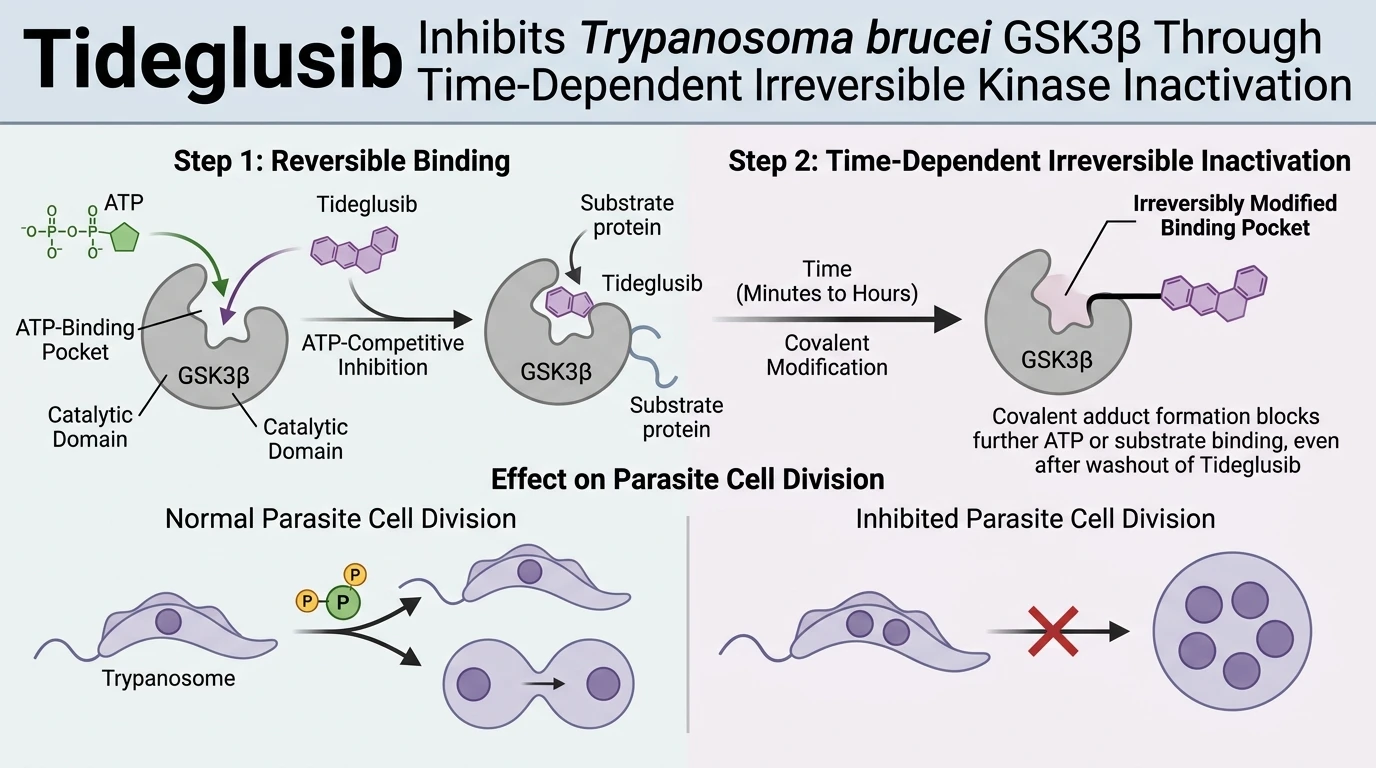
Through this screening paradigm, Tideglusib was identified as a time-dependent, irreversible inhibitor of TbGSK3β. Initial target engagement by Tideglusib proceeds through an ATP-competitive association step at the catalytic cleft. However, extended incubation reveals a transition from this reversible initial complex to an insurmountable, ATP non-competitive state. Following a 100-fold dilution of the pre-incubated enzyme-inhibitor complex, catalytic activity of TbGSK3β was not restored. This persistent loss of function indicates covalent engagement or an extremely slow dissociation rate under tested in vitro assay conditions.
The kinetic behavior of Tideglusib contrasts sharply with traditional ATP-competitive kinase inhibitors evaluated in identical assay formats. The reference compound GW8510 exhibited rapid equilibrium binding kinetics and remained strictly ATP-competitive regardless of pre-incubation duration. Unlike GW8510, the secondary transition demonstrated by Tideglusib renders the inhibition insurmountable by physiological concentrations of ATP. Target residence time is markedly prolonged as a consequence of this secondary non-competitive state, effectively decoupling target inactivation from fluctuating intracellular ATP levels.
In biological evaluation against bloodstream-form Trypanosoma brucei parasite cultures, Tideglusib inhibited cell proliferation with a half-maximal growth inhibition concentration (GI50) of 2.3 μM. At elevated parasite cell densities, the inhibitor exerted cytostatic rather than rapidly cytolytic effects. This density-dependent phenotypical profile aligns with sustained kinase suppression in rapidly dividing cells. Early MMOA screening successfully distinguished the long residence-time kinetic profile of Tideglusib from rapidly reversible hits, illustrating the value of kinetic characterization in lead selection for antiprotozoal drug discovery.
Kinetic Profiling and Parasite Growth Inhibition Synthesis
Copy code to add this image to your page
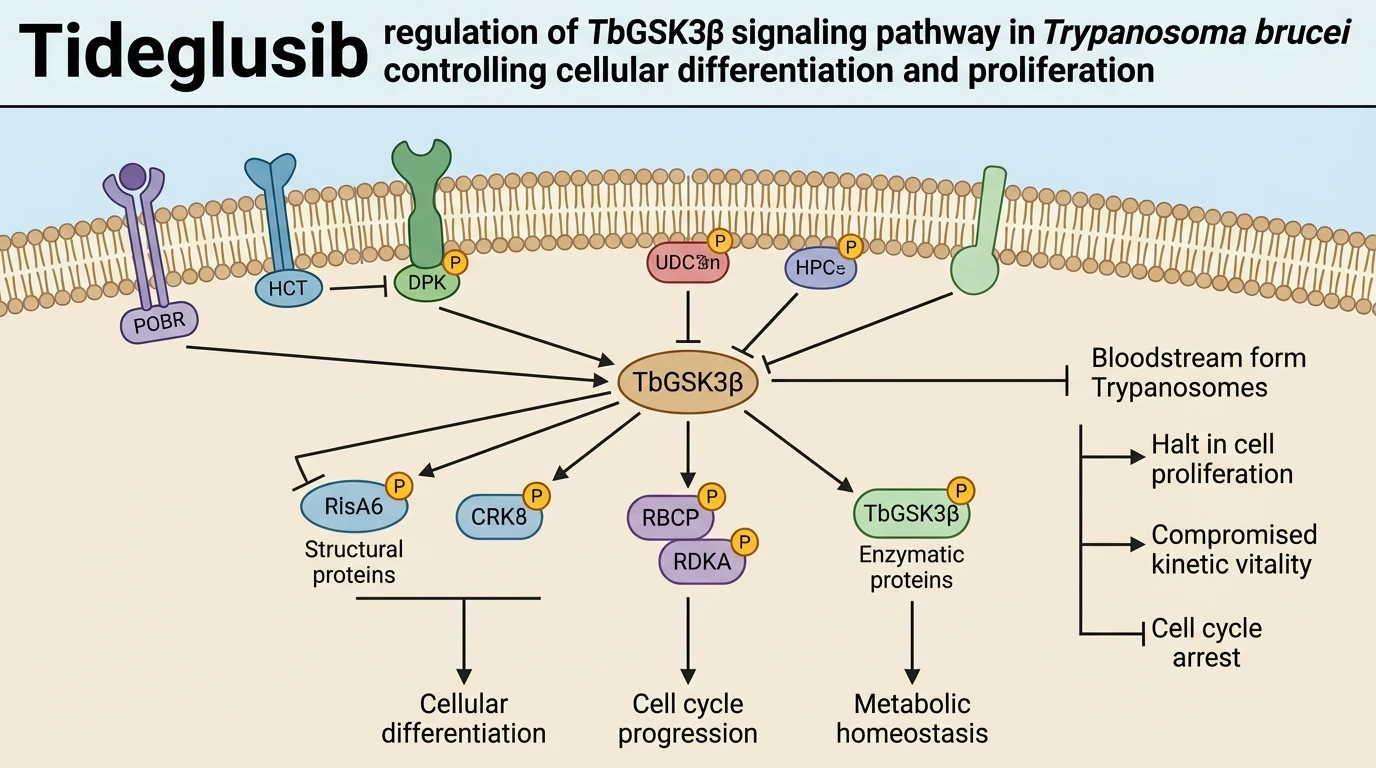
Tideglusib exhibits a two-step inhibition mechanism against Trypanosoma brucei GSK3β, beginning with ATP-competitive target engagement that rapidly transitions to time-dependent, irreversible, ATP non-competitive inhibition. The compound remains bound without activity recovery after significant dilution. Phenotypically, it arrests bloodstream parasite proliferation with a GI50 of 2.3 μM.
Time-Dependent Transition to Irreversible TbGSK3β Inactivation
Kinetic analysis using the four-point screening method demonstrated that initial enzyme engagement by Tideglusib involves competitive binding at the ATP catalytic cleft. Over extended incubation intervals, this transient complex undergoes a unimolecular conformational transition or covalent engagement, forming an irreversible target-inhibitor complex. Rapid 100-fold dilution assays failed to restore catalytic turnover of recombinant TbGSK3β. In contrast, the benchmark kinase inhibitor GW8510 maintained reversible, strictly ATP-competitive inhibition regardless of pre-incubation duration. These findings establish that insurmountable inactivation decouples drug efficacy from fluctuating intracellular ATP concentrations.
Bloodstream Parasite Proliferation Arrest at MicroMolar Concentrations
In phenotypic growth assays against bloodstream-form Trypanosoma brucei, Tideglusib exhibited concentration-dependent proliferation arrest with a GI50 of 2.3 μM. High-density parasite cultures exposed to the compound displayed marked cytostatic responses rather than rapid lytic clearance. This cytostatic profile reflects sustained target occupancy and inactivation of intracellular TbGSK3β pools. The observed activity highlights the utility of kinetic characterization in predicting cellular target engagement within protozoan disease models.