4-PBA (4-Phenylbutyric acid) Attenuates Endoplasmic Reticulum Stress in Shock
Copy code to add this image to your page
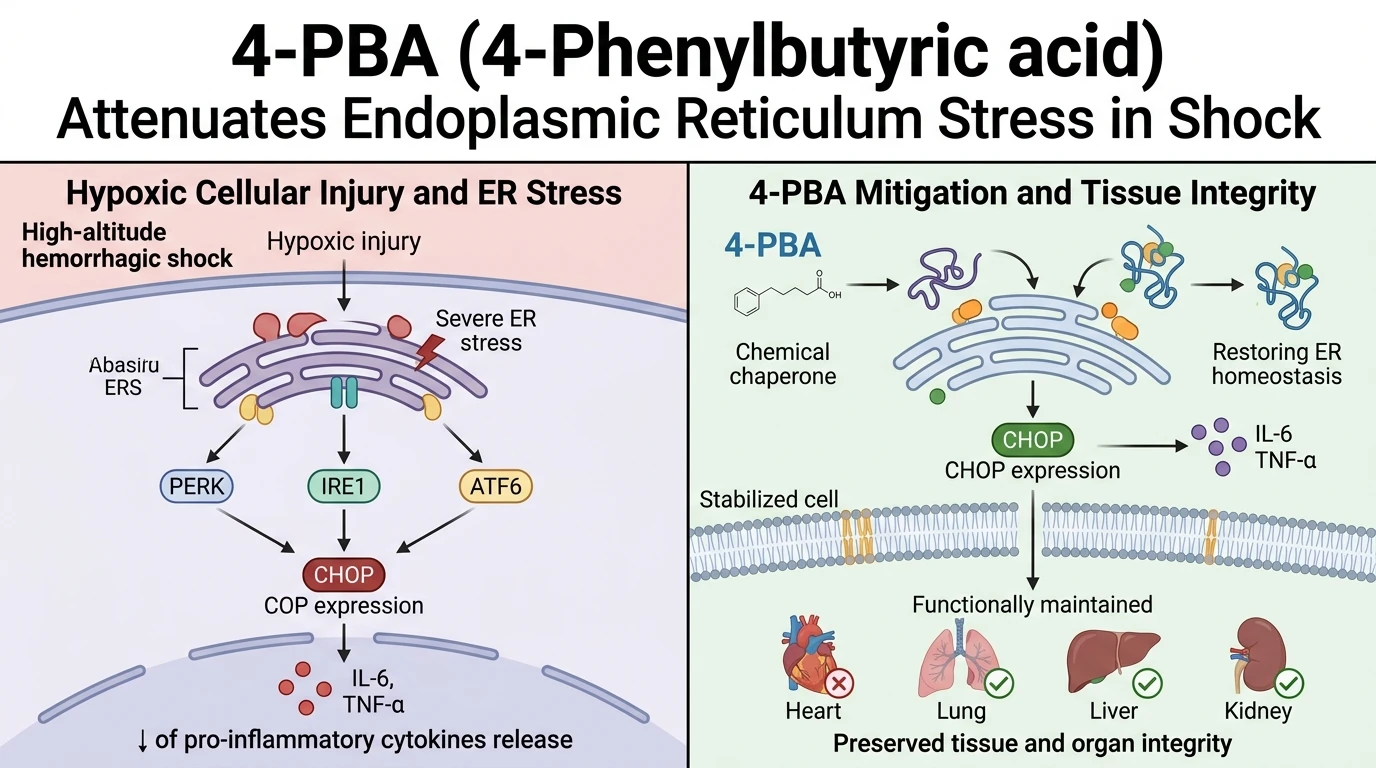
In severe trauma and high-altitude hypoxia, the window for effective resuscitation—often termed the golden period—is severely truncated due to accelerated microvascular failure and metabolic decompensation. High-altitude uncontrolled hemorrhagic shock (HAUHS) imposes dual physiological insults: severe arterial hypoxemia and critical hypoperfusion. Under these severe hypoxic-ischemic conditions, cellular homeostasis deteriorates rapidly, driving misfolded protein accumulation within the endoplasmic reticulum lumen. This accumulation activates endoplasmic reticulum stress pathways that trigger cellular apoptosis, tissue necrosis, and systemic cytokine release. Chemical chaperones targeting these specific stress mechanisms represent a targetable pharmacologic approach to preserve organ function during delayed prehospital transport.
In a rat model of HAUHS, administration of 4-PBA (4-Phenylbutyric acid) during hypotensive fluid resuscitation significantly enhanced hemodynamic stability and systemic recovery. The small-molecule chaperone stabilized mean arterial pressure (MAP) throughout the critical resuscitation phase, permitting controlled hypotensive maintenance without accelerating microvascular collapse. Quantitative hemodynamic monitoring revealed that adjunctive modulation via 4-PBA prolonged the effective hypotensive maintenance time by 243% compared to fluid resuscitation alone. This prolonged stability reduced active internal bleeding and significantly lowered total fluid resuscitation requirements, mitigating fluid overload and associated reperfusion injuries.
Organ-level histopathological and biochemical evaluations confirmed profound visceral protection across multiple organ systems. Severe ischemia-reperfusion injury typically leads to breakdown of microvascular barriers, precipitating microvascular leakage and organ failure. In HAUHS rats receiving 4-PBA, markers of cardiac, hepatic, and renal injury were substantially attenuated. Serum levels of aspartate aminotransferase, alanine aminotransferase, blood urea nitrogen, and serum creatinine remained close to baseline parameters. Furthermore, 4-PBA therapy markedly reduced cerebral and pulmonary edema, preserving tissue architecture and vascular barrier integrity in both high-altitude hypoxic brain and lung microenvironments.
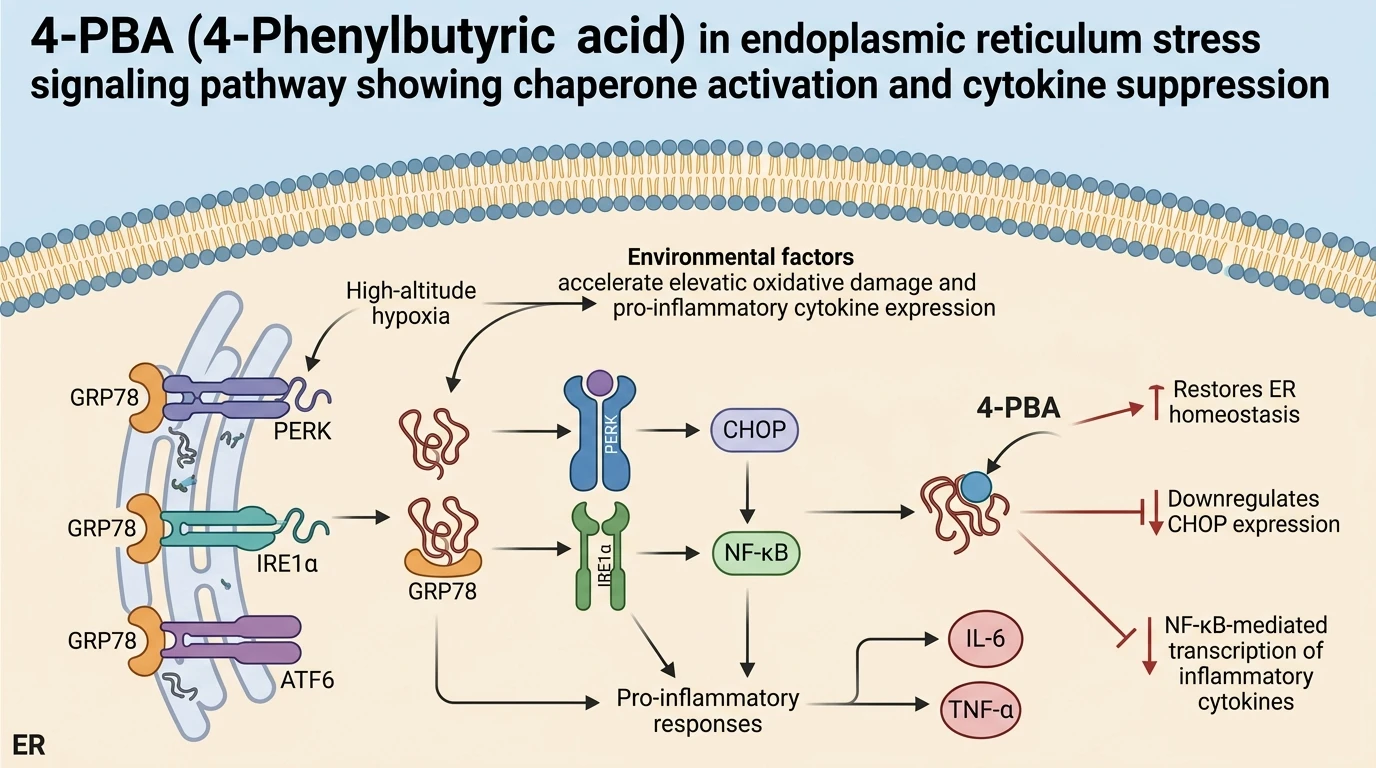
At the molecular level, the protective effects of 4-PBA correlate directly with the suppression of endoplasmic reticulum stress (ERS), oxidative stress markers, and circulating pro-inflammatory cytokines. HAUHS typically induces massive systemic surges in interleukin-6 (IL-6) and tumor necrosis factor-alpha (TNF-α), amplifying hyper-inflammatory responses and multiorgan breakdown. Co-administration of 4-PBA blocked the upstream initiation of ERS, suppressing downstream effector axes and halting cytokine transcription. Plasma levels of IL-6 and TNF-α were significantly reduced in 4-PBA-treated cohorts compared to non-treated control animals.
These physiological and biochemical improvements translated into marked survival benefits under simulated high-altitude conditions. Treatment with 4-PBA extended the prehospital therapeutic window by up to 2 hours, allowing sufficient time for definitive surgical intervention. Short-term survival metrics and 72-hour post-resuscitation survival rates increased significantly in the combination treatment group. While these preclinical observations remain to be validated in large-animal models and clinical cohorts, the findings establish 4-PBA as a potent pharmacological adjunct to hypotensive resuscitation in resource-limited, high-altitude trauma settings.
Hemodynamic Stabilization and Multi-Organ Protection Mechanics
Copy code to add this image to your page
4-PBA functions as a low-molecular-weight chemical chaperone that mitigates endoplasmic reticulum stress (ERS), oxidative stress, and hyper-inflammatory signaling. By binding exposed hydrophobic regions on misfolded proteins, 4-PBA prevents unfolded protein response activation, reducing downstream production of pro-inflammatory cytokines IL-6 and TNF-α. In high-altitude uncontrolled hemorrhagic shock, this target engagement preserves cardiac, hepatic, and renal tissue integrity, attenuates cerebral and pulmonary edema, stabilizes hemodynamics, and significantly extends survival windows.
Hemodynamic Stabilization and Reduced Fluid Requirements in Rats
Hypotensive resuscitation aims to minimize hemorrhage while maintaining minimal vital organ perfusion. In high-altitude environments, extreme hypoxemia impairs vascular tone control mechanisms. Co-administration of 4-PBA stabilized mean arterial pressure during fluid resuscitation. Hypotensive maintenance time extended by 243%. Consequently, total fluid volume requirements and secondary internal blood loss decreased significantly.
Suppression of Systemic Cytokines IL-6 and TNF-α
Systemic inflammation exacerbates microvascular permeability following hemorrhagic shock. High-altitude hypoxemia accelerates cytokine release through ER stress signaling nodes. In rat models of uncontrolled shock, administration of 4-PBA attenuated plasma concentrations of pro-inflammatory markers IL-6 and TNF-α. Cerebral and pulmonary edema markers showed parallel reductions. These findings indicate that modulating ER stress reduces vascular barrier breakdown.
Preservation of Renal and Hepatic Functional Biomarkers
Ischemia-reperfusion injury causes acute dysfunction in metabolically active organ beds. Renal and hepatic enzyme leakage indicates rapid cellular membrane damage during uncompensated shock. Serum creatinine and alanine aminotransferase levels remained significantly lower in animals receiving targeted chaperone therapy. Short-term and 72-hour survival rates increased substantially. These experimental outcomes support further exploration of chemical chaperones in acute trauma resuscitation protocols.