Baricitinib (LY3009104) LY3009104 suppresses JAK1/JAK2 signaling to improve COVID-19 survival
Copy code to add this image to your page
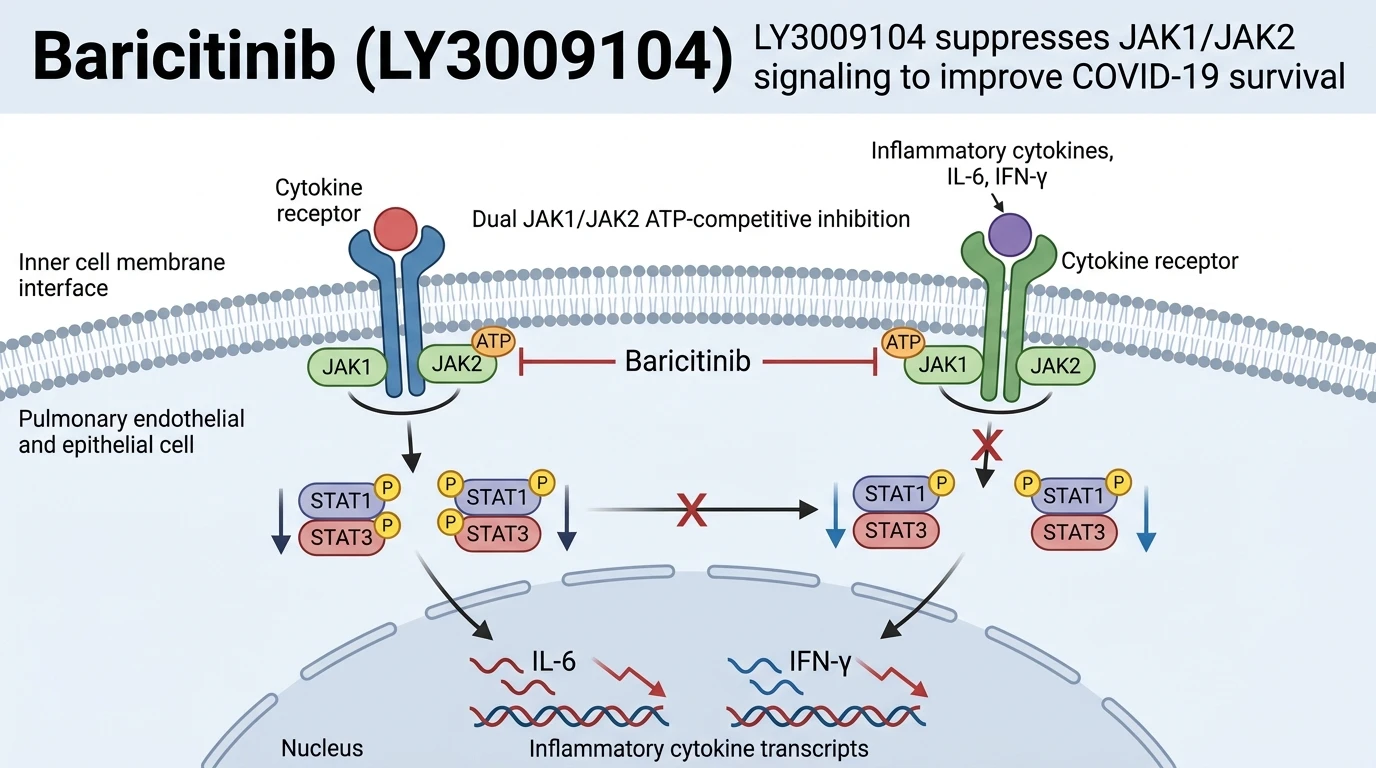
Severe coronavirus disease 2019 (COVID-19) is characterized by a dysregulated immune response in which excessive release of systemic pro-inflammatory cytokines drives acute respiratory distress syndrome (ARDS), multiorgan dysfunction, and elevated mortality. Interleukin-6 (IL-6), interferon-gamma (IFN-γ), and granulocyte-macrophage colony-stimulating factor (GM-CSF) rely predominantly on Janus Kinase 1 (JAK1) and Janus Kinase 2 (JAK2) catalytic signaling modules to execute transcriptional inflammatory programs. Targeted pharmacological suppression of this cascade presents a logical strategy to dampen systemic hyper-inflammation while maintaining basal antiviral host defenses.
Baricitinib (LY3009104) is an orally bioavailable, reversible inhibitor with potent selectivity for JAK1 and JAK2 (IC50 values of 5.9 nM and 5.7 nM, respectively). By competitively occupying the ATP-binding pocket of these kinase domains, the compound prevents enzymatic auto-phosphorylation and subsequent recruitment of Signal Transducer and Activator of Transcription (STAT) proteins. In severe viral pneumonia, attenuating STAT1 and STAT3 activation limits the downstream transactivation of chemokine networks that recruit neutrophils and monocyte-derived macrophages into pulmonary tissue spaces.
To establish the therapeutic efficacy of this pathway blockade, a broad meta-analysis synthesized clinical data across four randomized controlled trials encompassing 10,815 hospitalized COVID-19 patients. The primary endpoint analyses revealed that adjunct administration of baricitinib significantly lowered 28-day all-cause mortality compared to standard care or placebo (odds ratio [OR] 0.69, 95% confidence interval [CI] 0.50–0.94). This survival advantage was matched by a reduced rate of disease progression; the composite risk of requiring positive pressure ventilation, invasive mechanical ventilation, or dying within the study window fell by eleven percent (OR 0.89, 95% CI 0.80–0.99).
Beyond reducing critical illness progression and overall mortality, target engagement yielded measurable improvements in patient recovery dynamics. Hospitalization length was significantly shortened in treatment cohorts. Furthermore, time to clinical recovery—defined as reaching a status compatible with discharge or requiring minimal oxygen supplementation—was consistently reduced across trial arms. Crucially, the therapeutic benefit of small-molecule JAK1/JAK2 inhibition was most pronounced when combined with systemic corticosteroid therapy, such as dexamethasone. Corticosteroids provide broad, non-specific transcriptional repression, whereas selective JAK inhibition interrupts key upstream signaling hubs. This dual approach limits collateral tissue destruction without causing generalized immunosuppressive toxicity.
Clinical Efficacy and Modulation of Cytokine Cascades
Copy code to add this image to your page
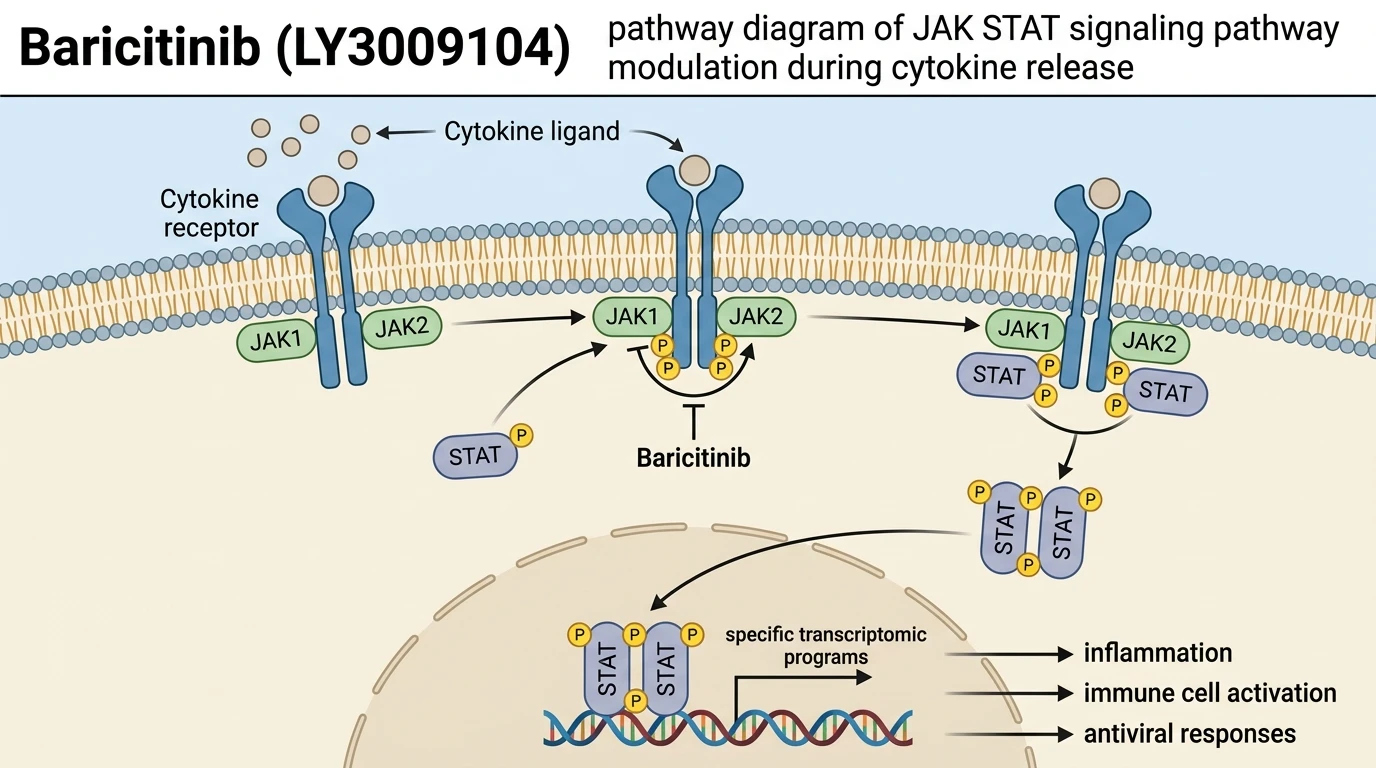
Baricitinib competitively inhibits the ATP-binding catalytic domains of Janus Kinases 1 and 2 (JAK1/JAK2). By halting downstream STAT phosphorylation and nuclear translocation, it blocks signal transduction of pro-inflammatory cytokines such as IL-6, IFN-gamma, and GM-CSF. This targeted suppression dampens hyper-inflammatory cytokine storms in severe viral infections without completely abolishing baseline immune activity.
Mortality Reduction and Attenuation of Respiratory Failure
Targeting hyper-inflammatory cascades alters the clinical trajectory of severe viral pneumonia. In a meta-analysis of 10,815 hospitalized patients, LY3009104 administration reduced 28-day mortality (OR 0.69, 95% CI 0.50–0.94). The risk of progression to non-invasive positive pressure ventilation, mechanical ventilation, or death was reduced (OR 0.89, 95% CI 0.80–0.99). Upstream inhibition of receptor-associated JAK1 and JAK2 blocks the phosphorylation of STAT dimers. Downstream transcription of pulmonary inflammatory mediators decreases within hours of administration. Consequently, alveolar epithelial tissue damage is mitigated under treated clinical protocols.
Accelerated Recovery and Synergy with Corticosteroids
Hospital length of stay dropped significantly among patients receiving adjunct targeted kinase therapy. Time to clinical recovery shortened compared to placebo groups. Small-molecule intervention with LY3009104 complemented standard dexamethasone regimens. Broad corticosteroid actions combined effectively with precise receptor signaling blockade; this dual mechanism suppressed systemic IL-6 release while preserving peripheral immune cell viability. Adverse event profiles between treatment and control arms remained comparable. Pharmacological blockade of JAK1/JAK2 thus restores physiological inflammatory balance without precipitating secondary opportunistic infections.