RAD001 (Everolimus) Resistance Mechanisms and Reversibility in Pancreatic Neuroendocrine Tumors
Copy code to add this image to your page
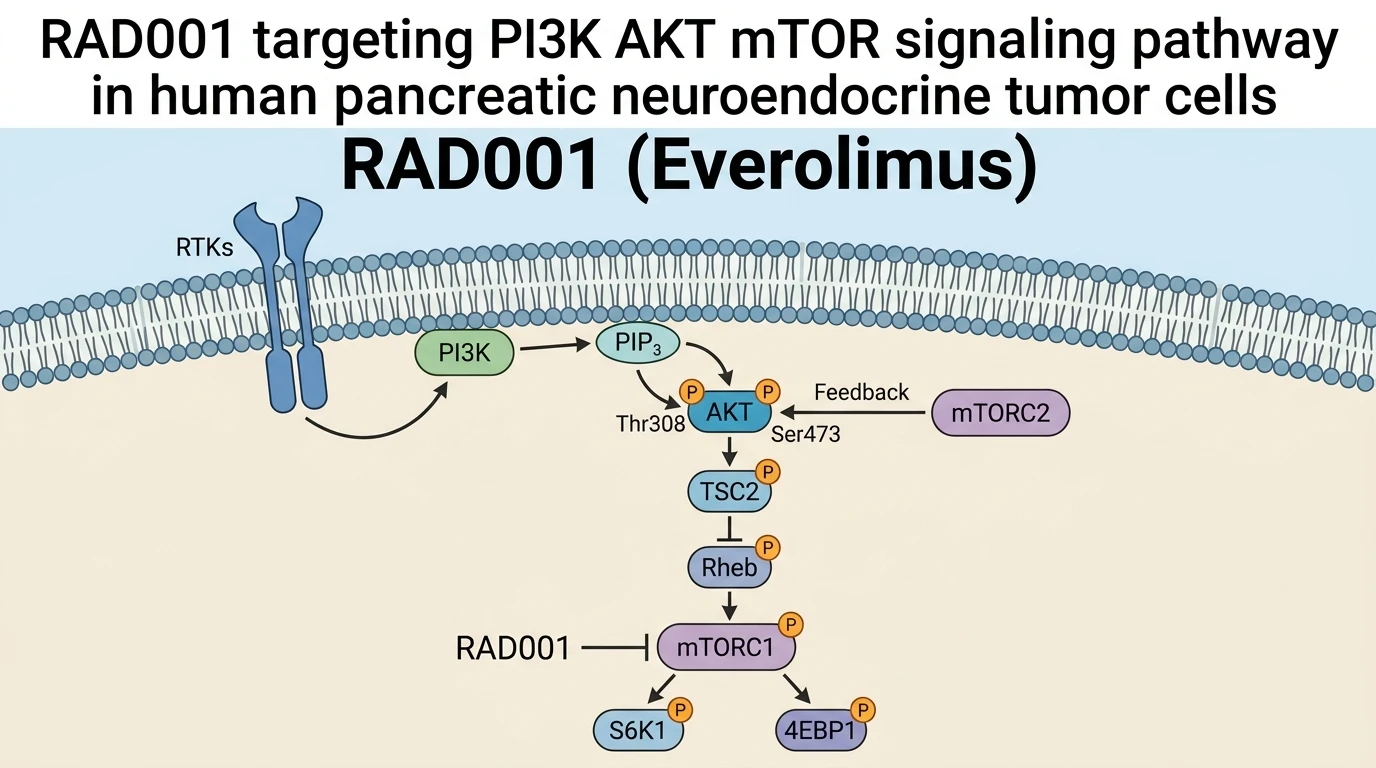
The macrolide derivative RAD001 (Everolimus) functions as an allosteric inhibitor of mammalian target of rapamycin complex 1 (mTORC1). By forming a gain-of-function complex with the intracellular immunophilin FKBP12, the drug binds the FKBP12-rapamycin-binding (FRB) domain of mTOR. This sterically restricts substrate access to the catalytic site. In clinical management of advanced pancreatic neuroendocrine tumors (PNETs), targeting mTORC1 suppresses hyperactivated protein translation and tumor growth. However, persistent pharmacological pressure frequently induces acquired drug resistance. To establish robust models of acquired refractory disease, human PNET cell lines—specifically BON-1 and QGP-1—were exposed to stepwise increasing concentrations of everolimus over a period exceeding 20 weeks. This long-term selection pressure yielded stably resistant sublines designated as BON-1/R and QGP-1/R.
Phenotypic characterization revealed pronounced cross-resistance to classic rapamycin analogs. The cells maintained active proliferation despite high micromolar drug exposure. Intriguingly, this resistant phenotype was not fixed permanently. Subjecting the resistant cell lines to a 10-12 week drug holiday completely restored pharmacological sensitivity to mTOR kinase signaling nodes. This reversibility indicates an epigenetic or transcriptional adaptation rather than permanent genomic mutagenesis within the kinase domain.
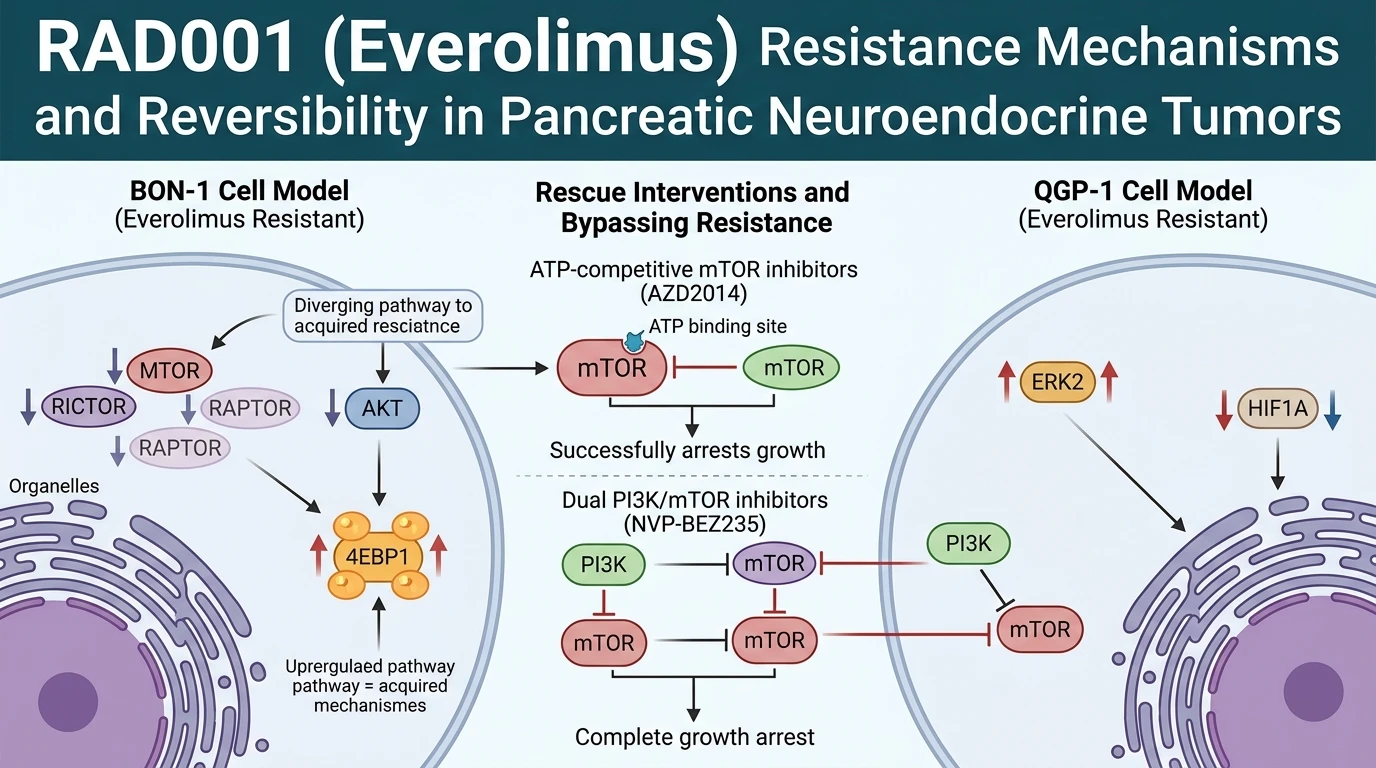
To overcome allosteric blockade failure, second-generation therapeutic strategies targeting distinct catalytic loci were evaluated. ATP-competitive active-site mTOR inhibitors—such as AZD2014 (vistusertib) and OSI-027—bind directly within the ATP-catalytic cleft of the kinase domain. These compounds effectively suppressed cell proliferation in both parental and resistant cohorts. Similarly, the dual PI3K-mTOR inhibitor NVP-BEZ235 (dactolisib) potently suppressed biomass accumulation and viability across all resistant models. These findings confirm that acquired resistance to allosteric inhibition does not render the central catalytic core uninhibitable under tested in vitro assay conditions.
Gene expression profiling uncovered marked mechanistic divergence between the two PNET sublines. Resistant BON-1/R cells displayed extensive downregulation of core pathway components. Transcripts for MTOR, RICTOR, RAPTOR, and AKT were concurrently suppressed. Concurrently, hyper-expression of 4EBP1 was observed. This expression pattern suggests a major recalibration of translational control, shifting cell survival away from canonical mTORC1/mTORC2 assembly. In contrast, QGP-1/R cells pursued a distinct transcriptional trajectory. QGP-1/R exhibited significant upregulation of ERK2 alongside downregulation of HIF1A. Mitogen-activated protein kinase (MAPK) pathway activation through ERK2 upregulation provides an alternative survival cascade; this bypasses direct mTOR dependency under continuous allosteric inhibition. Downregulation of HIF1A indicates metabolic restructuring under hypoxic signaling cues.
In experimental assays, the concentration-dependent efficacy of catalytic inhibitors remained consistent across parent and resistant sublines. AZD2014 achieved prompt suppression of downstream phosphorylation events. Viability dropped markedly within 48 hours of treatment. The selective potency of catalytic mTOR inhibition demonstrates that targeting both mTORC1 and mTORC2 activity circumvents the adaptive compensatory pathways triggered by chronic allosteric target engagement.
Transcriptional Adaptation and Therapeutic Bypass Strategies
Copy code to add this image to your page
Acquired resistance to the allosteric mTORC1 inhibitor RAD001 (Everolimus) develops in PNET cell lines (BON-1 and QGP-1) after chronic selection over 20 weeks. This resistance remains reversible after a 10-12 week drug holiday and shows cross-resistance to rapamycin. Resistance mechanisms are cell-line specific: BON-1/R exhibits downregulation of MTOR, RICTOR, RAPTOR, and AKT alongside 4EBP1 upregulation, whereas QGP-1/R shows ERK2 upregulation and HIF1A downregulation. ATP-competitive mTOR inhibitors (AZD2014, OSI-027) and dual PI3K-mTOR inhibitors (NVP-BEZ235) effectively bypass allosteric blockade and suppress proliferation.
Divergent Transcriptional Networks Drive Subline-Specific Resistance Modes
Pharmacological evaluation of resistant sublines revealed striking transcriptional heterogeneity between BON-1/R and QGP-1/R cells. In BON-1/R, quantitative gene expression assays confirmed suppression of MTOR, RICTOR, RAPTOR, and AKT transcripts. Conversely, translational repressor 4EBP1 was markedly upregulated. Downstream phosphorylation profiles showed diminished canonical target engagement. However, cell survival persisted. In QGP-1/R cells, resistance operated through non-canonical pathway crosstalk. Upregulated ERK2 expression driven by MAPK pathway reactivation sustained proliferative drive. Concurrently, HIF1A transcription dropped significantly. These divergent profiles demonstrate that RAD001 exposure forces PNET cells down distinct evolutionary trajectories dependent on background genetic wiring.
ATP-Competitive Kinase Blockade Overcomes Allosteric Refractory States
Traditional allosteric engagement of mTORC1 relies on stable FKBP12-drug complex formation. In both BON-1/R and QGP-1/R sublines, cross-resistance extended to rapamycin, confirming a general failure of allosteric suppression. Catalytic active-site inhibitors circumvented this limitation. ATP-competitive mTOR inhibitors AZD2014 and OSI-027 bound directly to the kinase catalytic domain. Proliferation dropped sharply across all tested sublines. Furthermore, treatment with dual PI3K-mTOR inhibitor NVP-BEZ235 completely restored antiproliferative responsiveness. Catalytic inhibition suppressed both mTORC1 and mTORC2 complexes simultaneously. Upstream PI3K node blockade prevented compensatory AKT reactivation.
Reversibility Profile and Drug Holiday Dynamics
Epigenetic plasticity plays a critical role in adaptive resistance under long-term drug pressure. Following continuous selection with RAD001 for over 20 weeks, drug withdrawal initiated gradual phenotypic reset. A drug holiday spanning 10 to 12 weeks fully restored sensitivity to allosteric inhibition. Baseline proliferation rates normalized. Subline sensitivity to rapamycin analogs returned to pre-selection control levels. These empirical observations confirm that resistance in these cell models stems from reversible transcriptional reprogramming rather than fixed catalytic domain mutations.