PF-562271 (VS-6062) Dual Targeting of FAK and Splicing Kinases
Copy code to add this image to your page
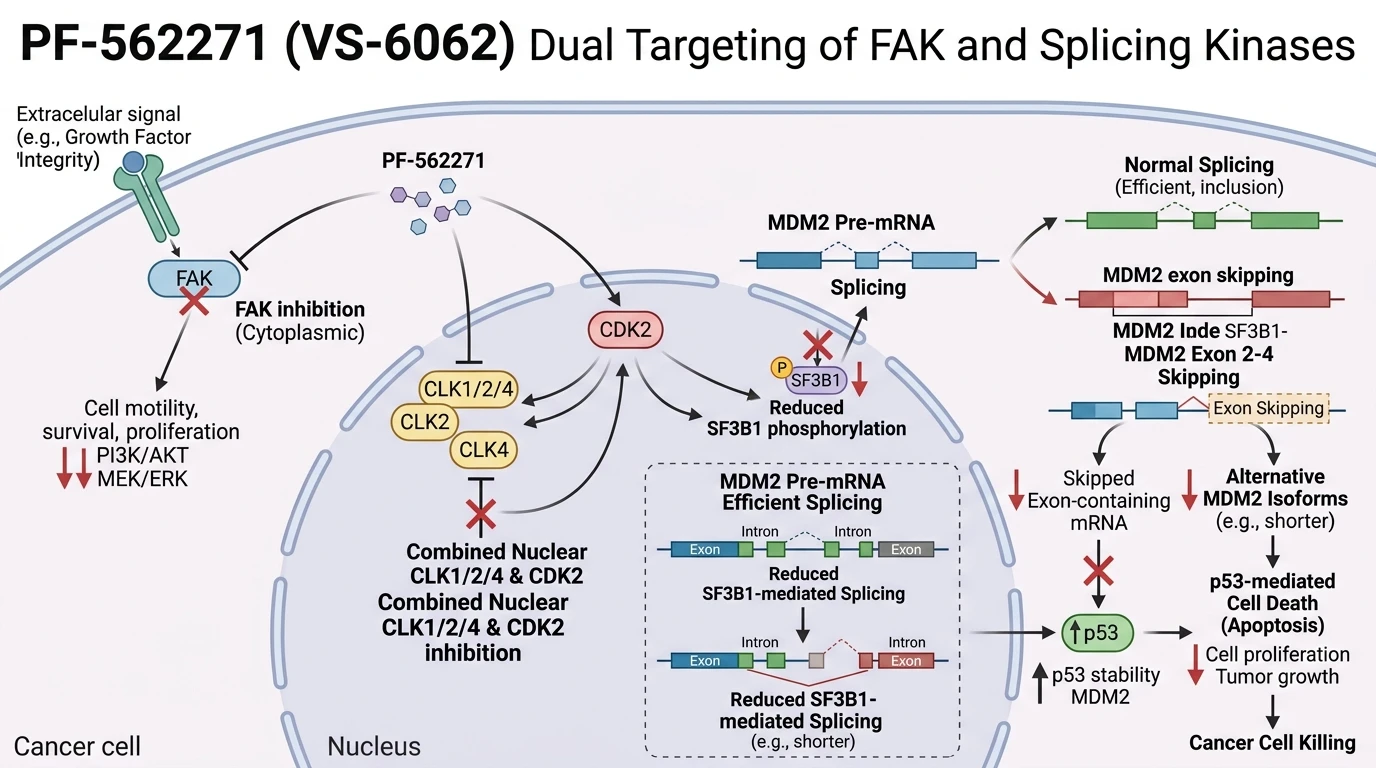
PF-562271 (VS-6062) was initially synthesized as an ATP-competitive, small-molecule inhibitor of Focal Adhesion Kinase (FAK). FAK operates as a mediator of integrin-mediated signal transduction, regulating cellular adhesion, migration, and invasive phenotypes across multiple solid malignancies. Initial clinical characterization established its biochemical potency against FAK-mediated focal adhesion dynamics. However, systematic phenotypic profiling using a Triple-Exon Skipping Luciferase Reporter (TESLR) screening platform uncovered an expanded pharmacological profile. Beyond its primary receptor-proximal kinase target, the compound functions as a nanomolar inhibitor of nuclear splicing-regulatory kinases, notably CLK1, CLK2, CLK4, and CDK2.
This dual mechanism bridges structural mechanotransduction signaling with post-transcriptional RNA processing. High-throughput chemical genetics revealed that the compound engages the ATP-binding pockets of CDC2-like kinases (CLKs) at low nanomolar concentrations. The inhibition of CLK isoforms directly suppresses the phosphorylation of serine/arginine-rich (SR) non-snRNP splicing factors. Concurrently, CDK2 inhibition perturbs cell cycle transitions and spliceosomal assembly dynamics. In nuclear compartments, this kinase inhibition cascade destabilizes the interaction between SR proteins and target pre-mRNA transcripts.
At the biochemical level, treatment with PF-562271 leads to quantifiable alterations in alternative splicing profiles within cultured human carcinoma models. Specifically, targeted RNA sequencing and reverse-transcriptase polymerase chain reaction (RT-PCR) analyses demonstrate distinct exon-skipping events in transcripts encoding MDM2 and RBM39. The skipping of critical coding exons in MDM2 disrupts its regulatory feedback loop with the p53 tumor suppressor, promoting target degradation or non-functional splice variant accumulation. Similarly, alternative splicing of RBM39—an essential RNA-binding protein involved in pre-mRNA splicing regulation—attenuates cell viability and impairs transcriptional elongation in dependent cancer lineages.
Additionally, targeted phosphoproteomic measurements indicate a significant reduction in the phosphorylation state of SF3B1, a core component of the U2 small nuclear ribonucleoprotein (snRNP) complex. Phosphorylation of SF3B1 at specific threonine residues is required for accurate 3'-splice site selection and spliceosome activation. Under tested in vitro assay conditions, the pharmacological reduction of SF3B1 phosphorylation disrupts proper spliceosome complex formation, causing widespread pre-mRNA splicing alterations. Adhering to rigorous pharmacological research standards, these biochemical observations clarify the multi-target mechanism underlying the agent's anti-proliferative activity.
This polypharmacological profile demonstrates that the antitumor activity of PF-562271 (VS-6062) is not restricted to focal adhesion disassembly and extracellular matrix signaling arrest. Instead, the simultaneous suppression of cytoplasmic FAK signal transduction and nuclear CLK/CDK2-mediated splicing factor phosphorylation induces compound cell stress. In patient-derived cancer cell models, this dual action compromises downstream survival networks more effectively than selective single-node inhibition. Structural modeling indicates that the molecule docks into the ATP-binding cleft of CLK family members through conserved hydrogen bonding interactions within the hinge region. This binding mode mirrors its interactions within the FAK catalytic domain, explaining its affinity across these distinct kinase families. Kinase selectivity panels revealed that while many traditional FAK inhibitors maintain high specificity for non-receptor tyrosine kinases, the molecule exhibits cross-family reactivity with cyclin-dependent and CDC2-like serine/threonine kinases. Downstream functional assays confirm that these splicing perturbations correlate directly with induced apoptotic cascades in high-grade tumor models.
Pharmacological Characterization of Dual Kinase Inhibition Profiles
Copy code to add this image to your page
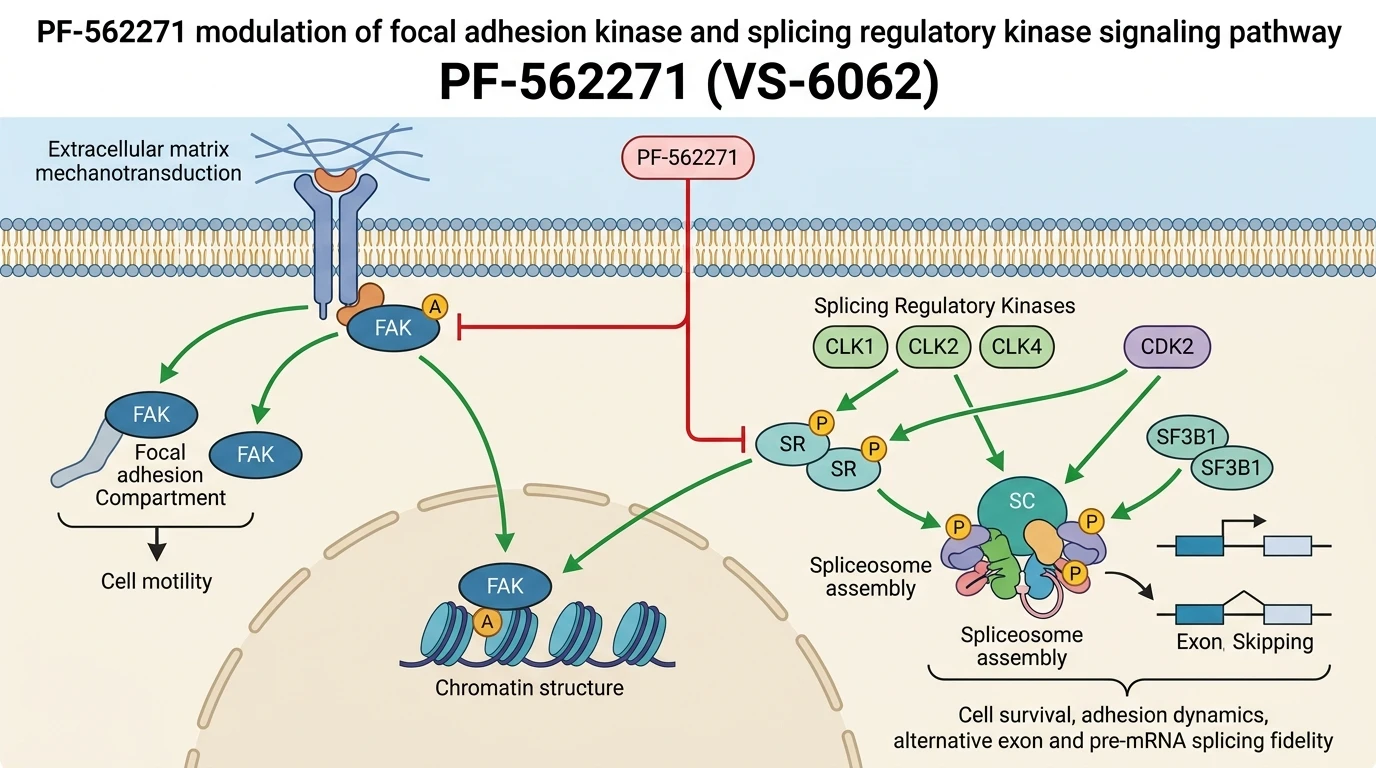
PF-562271 (VS-6062) exerts a dual mechanism of action by targeting Focal Adhesion Kinase (FAK) in the cytoplasm and splicing-regulatory kinases (CLK1, CLK2, CLK4, CDK2) in the nucleus. Inhibition of these CDC2-like and cyclin-dependent kinases suppresses the phosphorylation of spliceosomal components, including SF3B1. This reduction alters pre-mRNA processing, driving targeted exon-skipping events in transcripts such as MDM2 and RBM39. The synergistic arrest of focal adhesion signaling and pre-mRNA splicing destabilizes tumor cell viability across experimental cancer models.
TESLR Screen Identifies Nanomolar Splicing Kinase Inhibition
Systematic screening using the TESLR reporter system exposed the splicing modulation activity of PF-562271. In vitro kinase assays confirmed potent inhibition against CLK1, CLK2, CLK4, and CDK2. Enzymatic IC50 values remained in the low nanomolar range. Kinetic analysis demonstrated competitive inhibition with ATP across all tested isoforms. In cultured human cancer lines, target engagement occurred rapidly following exposure. This biochemical activity altered nuclear phosphorylation profiles within two hours. These findings demonstrate direct inhibition of splicing regulatory kinases distinct from focal adhesion targets.
Induction of MDM2 Exon Skipping and Reduced SF3B1 Phosphorylation
Application of PF-562271 to carcinoma cell lines resulted in marked exon skipping within MDM2 and RBM39 pre-mRNA transcripts. Quantitative RT-PCR confirmed the accumulation of truncated mRNA isoforms lacking critical functional domains. Downstream, Western blot analysis revealed reduced phosphorylation of SF3B1 at designated threonine residues. Spliceosomal assembly was consequently disrupted. Cell viability assays indicated elevated apoptosis following transcript destabilization. These molecular events occurred at physiologically relevant concentrations in patient-derived models. The observed cytotoxic response reflects combined target suppression across focal adhesion and pre-mRNA splicing networks.